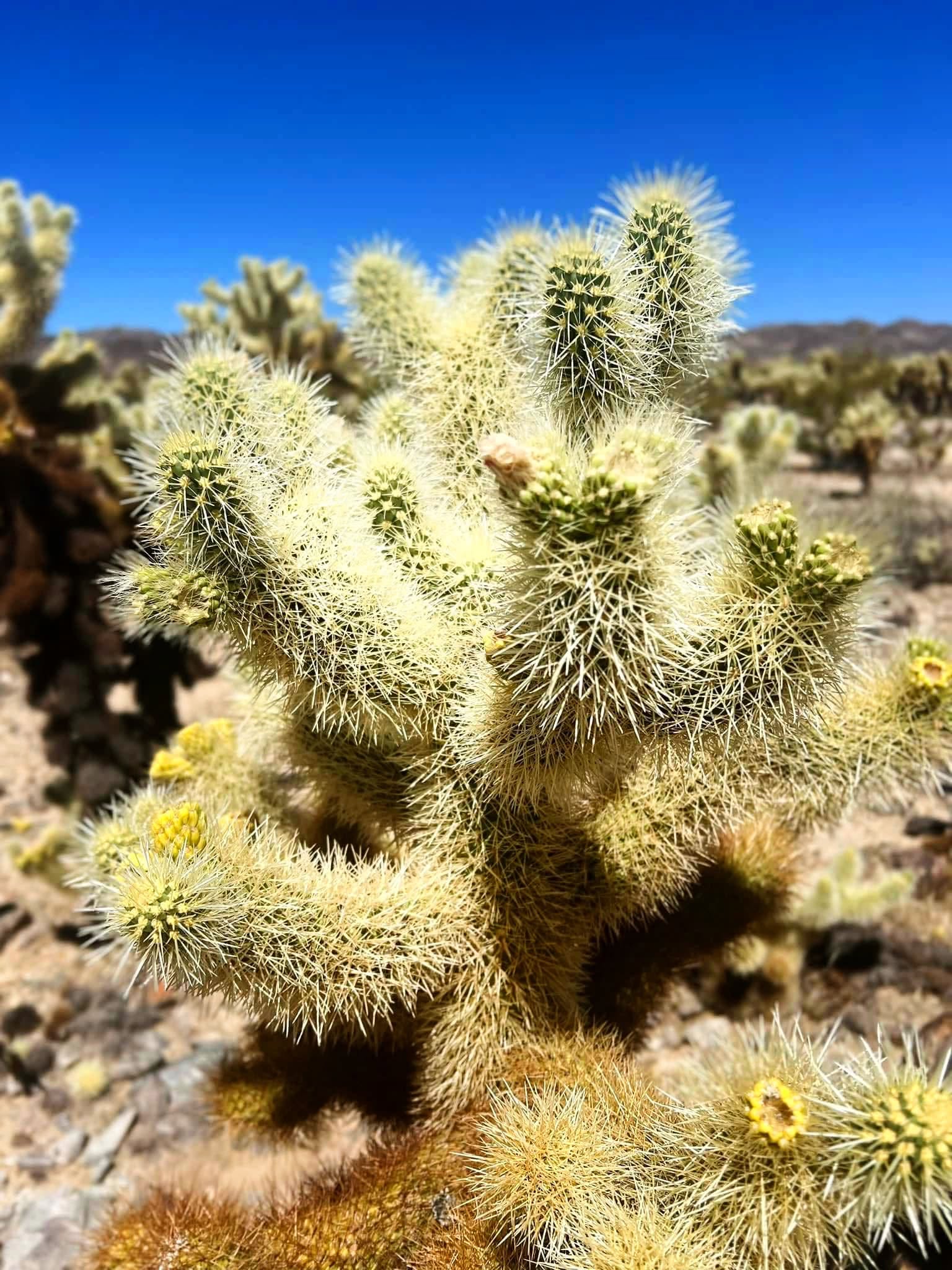

The teddy-bear cholla (Cylindropuntia bigelovii) is one of the most distinctive cacti of the North American deserts. Despite its soft-looking, almost glowing appearance, the “fur” is actually a dense covering of sharp, barbed spines. Mature plants commonly develop a dark trunk topped by clusters of cylindrical branches, while spring flowers are typically yellow-green, sometimes with reddish outer portions. The plant is also called “jumping cholla,” although its segments do not literally jump; rather, the loosely attached joints break away easily when brushed by an animal, clothing, or a hiker. For travelers, this makes admiring the cactus from a safe distance especially important, including watching for detached joints lying on the ground (National Park Service [NPS], n.d.).
Teddy-bear cholla is native to the deserts of the southwestern United States and northwestern Mexico, with its strongest association with hot portions of the Mojave and Sonoran desert regions. Kew’s Plants of the World Online records its native distribution from southern Nevada across parts of the American Southwest into northwestern Mexico, where it inhabits desert and dry-shrubland environments (Royal Botanic Gardens, Kew, 2026). It is particularly conspicuous on rocky slopes, gravelly bajadas, alluvial fans, and other well-drained desert terrain. Dense stands can sometimes dominate entire patches of landscape; one famous example is the Cholla Cactus Garden in Joshua Tree National Park, where a short nature trail passes through several hectares dominated by teddy-bear cholla (NPS, n.d.).
Biologically, teddy-bear cholla is remarkably specialized for both water conservation and vegetative reproduction. Like other cacti, it uses crassulacean acid metabolism, or CAM photosynthesis, opening its stomata mainly at night so it can take in carbon dioxide while limiting daytime water loss (NPS, n.d.). Its densely packed spines provide defense and also help shade the photosynthetic stems. Reproduction is especially unusual: many populations produce few or no viable seeds, and new plants instead develop from detached stem segments that root after falling or being transported by animals. Teddy-bear cholla is commonly triploid, which helps explain its limited sexual reproduction and extensive clonal growth (Ramadoss et al., 2025). Its formidable architecture also benefits desert wildlife—packrats use cholla segments around their middens, while cactus wrens and other small birds can nest among the spines, where predators have difficulty reaching them (NPS, n.d.).
Recent science is revealing that this familiar desert cactus has a surprisingly interesting evolutionary story. A 2025 genetic study led by researchers at San Diego State University sampled C. bigelovii and several related cholla species, including plants from Joshua Tree National Park. The researchers found generally low genetic diversity and strong genetic differentiation within the genus Cylindropuntia, raising questions about how some cholla populations may respond to increasingly extreme environmental conditions; C. bigelovii was especially interesting because its triploid genetics and predominantly clonal reproduction differ markedly from the sexually reproducing species studied (Ramadoss et al., 2025). Earlier biomechanical research also showed how perfectly the cactus is engineered for this lifestyle: experiments found that C. bigelovii branch junctions break under comparatively small forces, allowing segments to detach, hitch rides on animals, and establish new plants elsewhere—turning what seems like structural weakness into an effective reproductive strategy (Mylo et al., 2022).
References:
Arizona-Sonora Desert Museum. (n.d.). Genus Opuntia, including Cylindropuntia: Teddy bear cholla. Arizona-Sonora Desert Museum species account
Mylo, M. D., Hoppe, A., Pastewka, L., Speck, T., & Speck, O. (2022). Elastic property and fracture mechanics of lateral branch-branch junctions in cacti: A case study of Opuntia ficus-indica and Cylindropuntia bigelovii. Frontiers in Plant Science, 13, 950860. Frontiers in Plant Science article
National Park Service. (n.d.). Cholla Cactus Garden—Joshua Tree National Park. National Park Service: Cholla Cactus Garden
National Park Service. (n.d.). Cacti—Organ Pipe Cactus National Monument. National Park Service: Teddy-bear cholla information
Ramadoss, N., Steele, S., & Flores-Renteria, L. (2025). Prickly problems: Cylindropuntia‘s low genetic diversity despite inbreeding avoidance. Ecology and Evolution, 15(4), e71213. Wiley full-text research article
Royal Botanic Gardens, Kew. (2026). Cylindropuntia bigelovii (Engelm.) F.M.Knuth. Plants of the World Online. Kew Plants of the World Online
AI Disclosure Statement:
Artificial intelligence tools were used in the creation of this page, including elements such as writing, image enhancement, voice enhancement, and/or editing support. All final creative decisions were made by the creator.

Leave a Reply