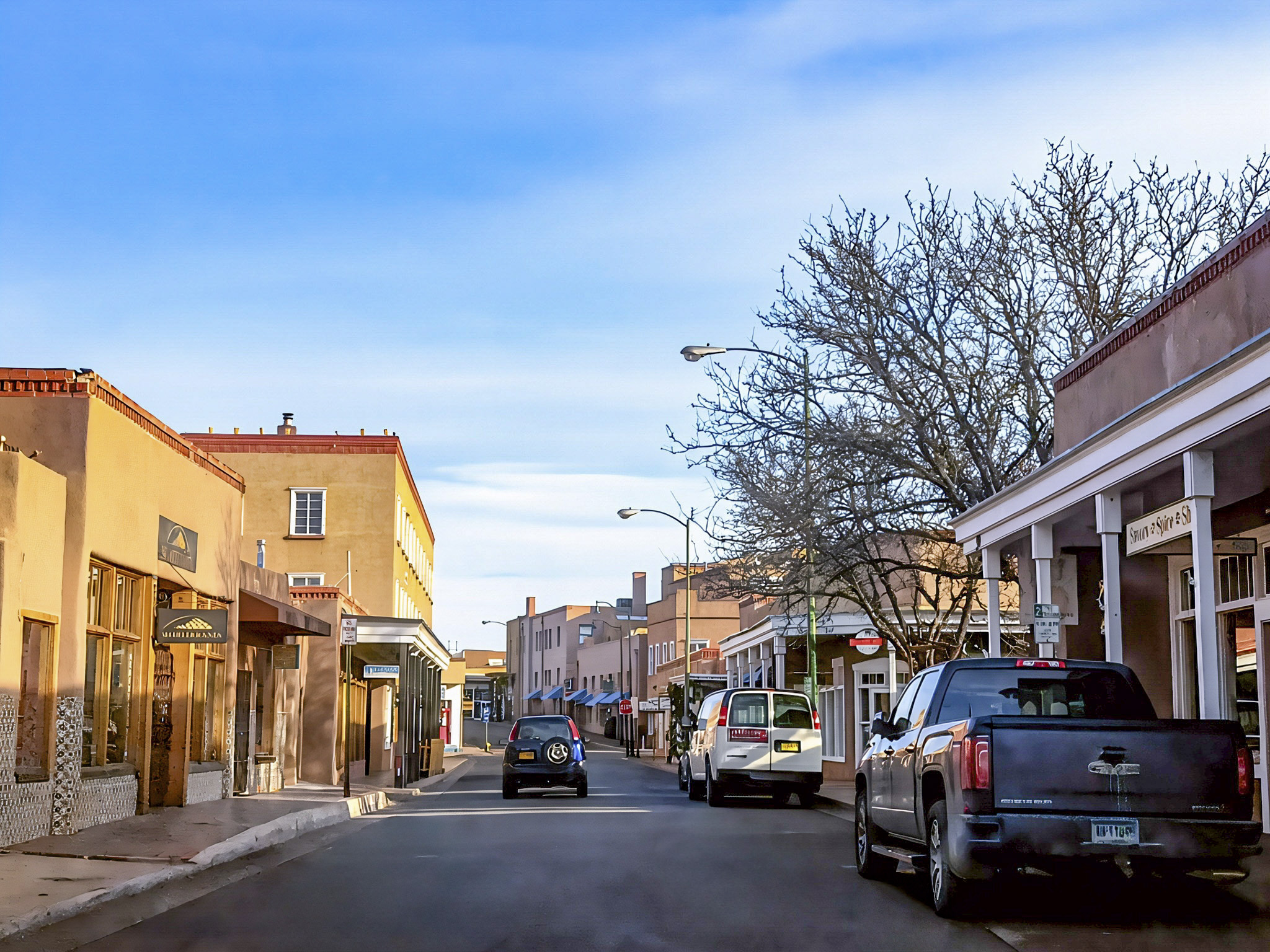

Santa Fe, New Mexico’s capital, brings together centuries of human history and the mountain landscapes of the American Southwest. Sitting roughly 7,000 feet above sea level near the Sangre de Cristo Mountains, it is the highest state capital in the United States. Spanish colonists established the city around its central Plaza in 1610, in a landscape already inhabited by Indigenous communities. Santa Fe later became a crossroads connecting the Santa Fe Trail, the Old Spanish Trail, and El Camino Real de Tierra Adentro, linking communities through trade and cultural exchange. Today, travelers can explore much of its historic center on foot, moving between museums, galleries, restaurants, and shops. Comfortable walking shoes and layers are useful because the city’s elevation brings cool conditions, especially during winter (National Park Service [NPS], 2026; TOURISM Santa Fe, n.d.-c).
Santa Fe Plaza is an excellent starting point for understanding the city’s complicated past. Originally a gathering place for commerce and colonial government, it became a major trading center after Mexico opened commerce with the United States in 1821. It also witnessed the Pueblo Revolt of 1680, when Indigenous resistance drove Spanish colonists from the region. Along its northern edge, the Palace of the Governors preserves another part of this history: the adobe building served successive governments and now forms part of the New Mexico History Museum. Visitors can explore the museum, browse downtown businesses, and enjoy the Plaza’s public spaces. The surrounding architecture also tells a story of change; many buildings reflect the Spanish Pueblo Revival movement that helped shape Santa Fe’s identity as a tourism destination in the early twentieth century (NPS, 2026; New Mexico History Museum, n.d.).

Several nearby landmarks make a downtown walk especially rewarding. The Cathedral Basilica of St. Francis of Assisi was built under Bishop Jean-Baptiste Lamy’s direction beginning in 1869, with French architects and Italian stonemasons contributing to its Romanesque design. Remarkably, construction proceeded around an older adobe church, which was later dismantled after the new walls were completed. Nearby, La Fonda on the Plaza connects Santa Fe’s hospitality traditions with the railroad era: its present building dates to 1922 and later operated as a Harvey House hotel. Farther along San Francisco Street, Burro Alley recalls the working animals that once carried firewood into town for sale. Together with the New Mexico Museum of Art, downtown galleries, and local restaurants, these places offer a walking itinerary combining architecture, regional art, and everyday history (Cathedral Basilica of St. Francis of Assisi, n.d.; La Fonda on the Plaza, n.d.; TOURISM Santa Fe, n.d.-b).
For science-lovers, Santa Fe’s surroundings extend the experience beyond its historic streets. The nearby Sangre de Cristo Mountains belong to the southern Rocky Mountains, making the city a convenient base for exploring the transition between urban landscapes and mountain environments (New Mexico Museum of Natural History and Science, n.d.). A particularly accessible nature destination is the Randall Davey Audubon Center and Sanctuary, a few miles from downtown. Its trails pass through habitats ranging from meadows to ponderosa pine forest, while native plant gardens offer opportunities to observe relationships among plants, birds, and pollinators. More than 190 bird species have been recorded there over the years, illustrating the ecological richness of the Santa Fe River watershed. Combine a museum visit with a nature walk, and check current opening hours and trail conditions before heading out (National Audubon Society, n.d.).
References
- Cathedral Basilica of St. Francis of Assisi. (n.d.). Our parish history.
- La Fonda on the Plaza. (n.d.). Santa Fe history.
- National Audubon Society. (n.d.). Plan your visit to the Randall Davey Audubon Center.
- National Park Service. (2026). Santa Fe Plaza.
- New Mexico History Museum. (n.d.). The Palace of the Governors.
- New Mexico Museum of Natural History and Science. (n.d.). A brief guide to New Mexico geology.
- TOURISM Santa Fe. (n.d.-a). Fast FAQs.
- TOURISM Santa Fe. (n.d.-b). Plaza and downtown.
- TOURISM Santa Fe. (n.d.-c). Santa Fe weather.


AI Disclosure Statement:
Artificial intelligence tools were used in the creation of this page, including elements such as writing, image enhancement/generation, voice enhancement, and/or editing support. All final creative decisions were made by the creator.
Leave a Reply