

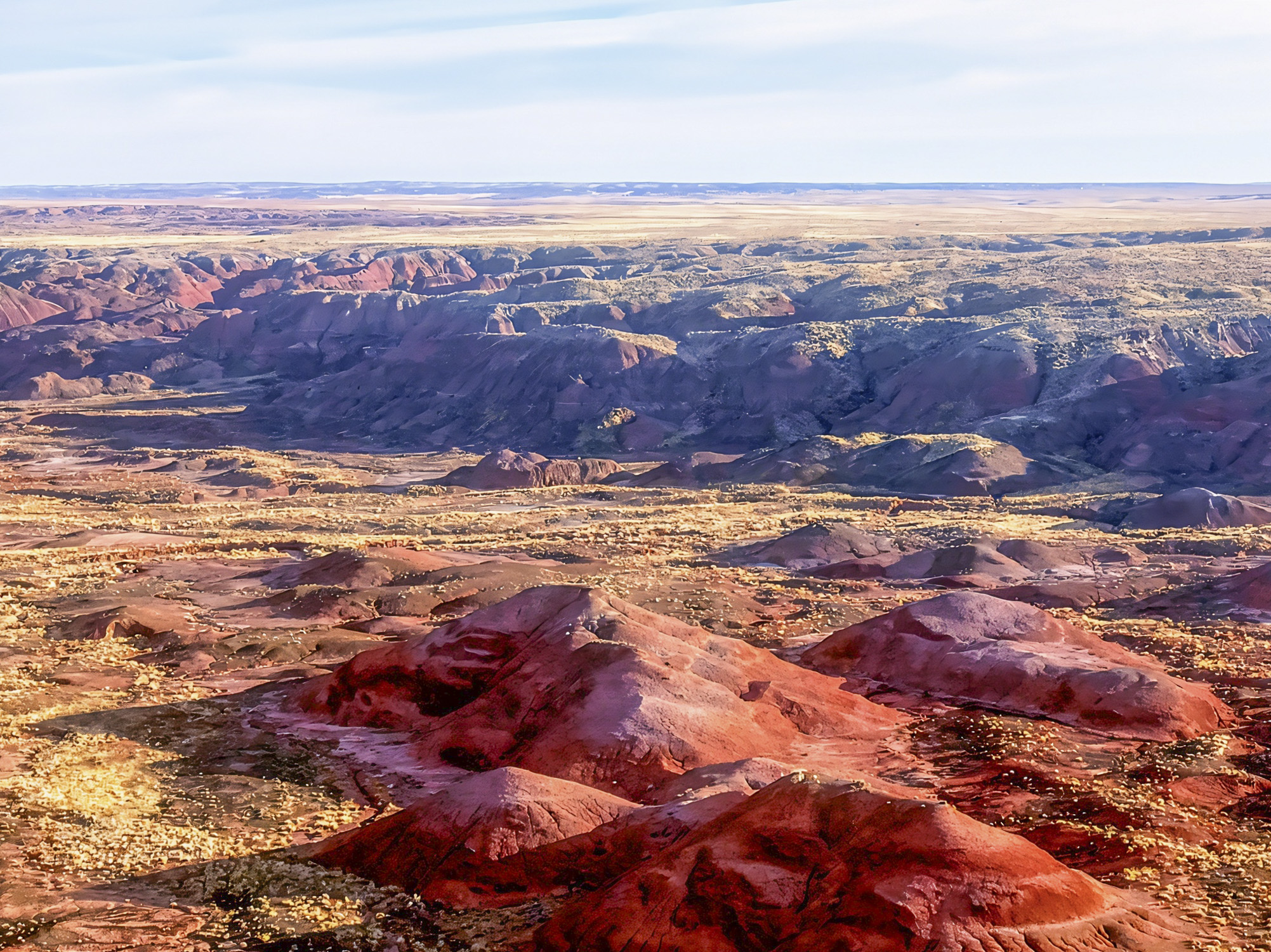
The Tepees in Petrified Forest National Park are cone-shaped hills striped with blue-gray, purple, and reddish sediment, making them a memorable stop on a road trip through northeastern Arizona. Their name refers to their resemblance to tipis, although the National Park Service notes that tipis are not traditional dwellings of this region. Located along the main park road about 14 miles from the northern entrance, the Tepees have a designated pullout for enjoying the scenery and taking photographs. Adventurous visitors can also ask rangers about the nearby Blue Forest Trail, an approximately three-mile round-trip route through colorful badlands that requires route-finding skills. Leave petrified wood and other natural objects where you find them, and avoid climbing fragile slopes (National Park Service [NPS], 2021, 2024).
The Tepees expose the Blue Mesa Member of the Chinle Formation, a sequence of sedimentary rocks deposited during the Late Triassic, more than 200 million years ago. Mud, silt, and sand accumulated in an ancient river-and-floodplain landscape before becoming rock; later erosion sculpted these deposits into the hills visible today. Their colorful bands preserve clues about ancient soils and groundwater. Reddish layers developed where iron minerals oxidized, much like rust, while blue-green shades reflect oxygen-poor conditions associated with waterlogged soils. Looking across these slopes is therefore a way of reading changes in an ancient environment, with each band contributing another piece of the story (NPS, 2020).

Although the exposed hills appear nearly bare, the surrounding park supports a living grassland ecosystem with wildflowers, shrubs, cacti, and other plants adapted to limited rainfall. Some plants survive dry periods as dormant seeds, while others conserve water through small leaves or specialized tissues. Birds, lizards, and rabbits are among the animals visitors most frequently encounter in the park, although sightings depend on weather and season. Many animals reduce their exposure to summer heat by becoming active around dawn, dusk, or at night. For travelers, watching the vegetation and wildlife around the badlands adds another layer of interest: this landscape preserves ancient life while continuing to support organisms adapted to a demanding environment (NPS, 2025a, 2025b).
Among the latest research developments from the wider park is the description of Sonselasuchus cedrus, an unusual ancient crocodile relative studied by Elliott Armour Smith and Christian Sidor. Researchers examined hundreds of fossil bones and inferred that the animal may have moved on four legs when young before becoming primarily two-legged as it grew. This interpretation comes from changes in the proportions of its forelimbs and hindlimbs. The discovery concerns a separate fossil locality within Petrified Forest, rather than the Tepees themselves, but it reveals the remarkable variety of animals preserved in the park’s Triassic rocks. For science-loving visitors, it makes the surrounding badlands especially compelling: their eroding layers continue to provide evidence that changes our understanding of prehistoric ecosystems (Smith & Sidor, 2026).


AI Disclosure Statement:
Artificial intelligence tools were used in the creation of this page, including elements such as writing, image enhancement/generation, voice enhancement, and/or editing support. All final creative decisions were made by the creator.


Leave a Reply