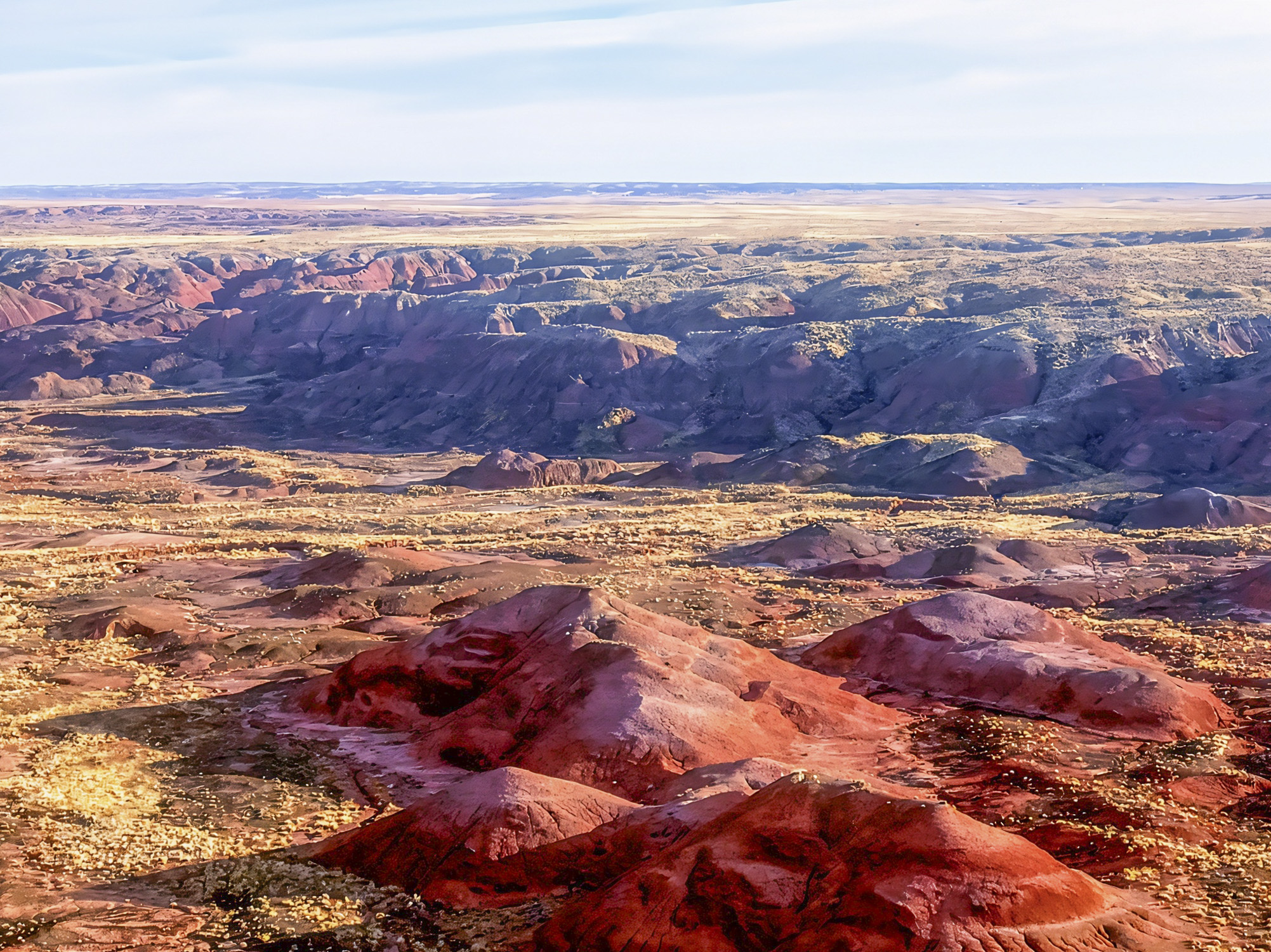

The Painted Desert in Petrified Forest National Park is a landscape of layered hills, flat-topped mesas, and deeply eroded badlands in northeastern Arizona. Its red, pink, purple, and gray bands make it a rewarding destination for travelers interested in photography and Earth’s history. Although visitors often associate the Painted Desert with the park’s northern overlooks, the entire park lies within this much larger geographic region, which extends from near the Grand Canyon toward eastern Arizona. Within the park, the northern badlands are predominantly red, while blue, gray, and purple layers become prominent farther south. This variety makes a drive through the park an opportunity to explore different parts of the same colorful landscape (National Park Service [NPS], 2025).
The landscape’s geological story begins more than 200 million years ago, during the Late Triassic, when rivers deposited the sediments that became the Chinle Formation. Many colorful layers preserve evidence of ancient soils and changing groundwater conditions. Reddish shades developed when iron minerals reacted with oxygen, much like rust, while some greenish and bluish layers formed under conditions with less oxygen. Volcanic ash also contributed material that altered into bentonite clay, which expands when wet and contracts as it dries. This shifting surface discourages plant growth and leaves slopes vulnerable to erosion. Rainwater gradually cuts channels and gullies through the soft rock, continually reshaping the badlands. The scenery therefore records both ancient environments and geological processes still happening today (NPS, 2020, 2025).

For a visit focused on the northern Painted Desert, travelers can reach the park’s north entrance from Interstate 40 at Exit 311. The approximately 28-mile park road connects the northern and southern entrances, allowing a broader visit that combines colorful overlooks with petrified-wood sites. For a short walk, the Painted Desert Rim Trail runs between Tawa Point and Kachina Point and measures about one mile round trip. It follows the rim through woodland, offering expansive views and opportunities to notice plants and birds. Its unpaved surface and uneven sections can make it unsuitable for some mobility devices. Check park operating hours before arriving, since the gates close in the evening, and leave rocks, fossils, and petrified wood where they belong (NPS, 2021, 2023, 2025).
Despite its name and barren-looking slopes, the Painted Desert supports a varied living landscape. Much of the surrounding park is semiarid grassland, with shrublands, small woodlands, and habitats associated with seasonal waterways. Above the badland rim, native grasses support animals such as pronghorn, hares, quail, and songbirds. Junipers and cliffroses grow around the northern rim, while woodland habitats provide food and shelter for mule deer, cottontails, lizards, and coyotes. Even the sparsely vegetated badlands support hardy plants such as shadscale and fluff grass, along with visiting birds and small animals. For science-loving travelers, these differences reveal a close connection between geology and biology: soil properties, elevation, and water availability help determine which organisms can survive in each part of the landscape (NPS, 2022).


References
National Park Service. (2020). Geologic formations. https://www.nps.gov/pefo/learn/nature/geologicformations.htm
National Park Service. (2021). Painted Desert Rim Trail. https://www.nps.gov/places/painted-desert-rim-trail.htm
National Park Service. (2022). Current environment. https://www.nps.gov/pefo/learn/nature/current-environment.htm
National Park Service. (2023). Directions. https://www.nps.gov/pefo/planyourvisit/directions.htm
National Park Service. (2025). Frequently asked questions. https://www.nps.gov/pefo/faqs.htm
AI Disclosure Statement:
Artificial intelligence tools were used in the creation of this page, including elements such as writing, image enhancement/generation, voice enhancement, and/or editing support. All final creative decisions were made by the creator.


Leave a Reply