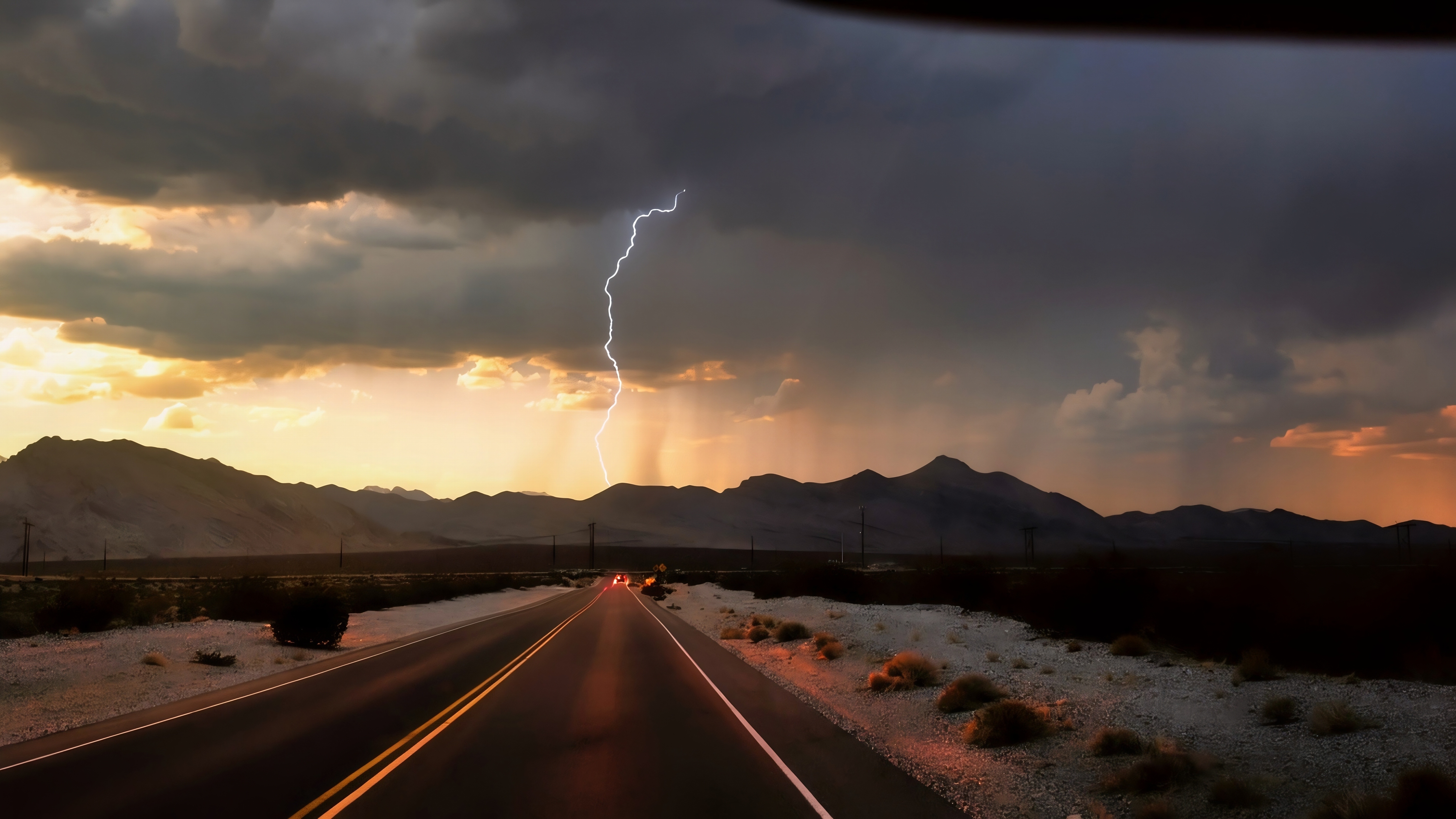

Lightning and rain over the Nevada desert create a dramatic contrast between illuminated storm clouds and the normally dry landscape. Lightning forms inside a thunderstorm when powerful updrafts carry small ice crystals upward while heavier graupel and hail descend; collisions among these particles transfer and separate electrical charges. As the resulting electric field intensifies enough to overcome the insulating resistance of the air, electricity is discharged within the cloud, between clouds, or toward the ground as lightning (National Severe Storms Laboratory [NSSL], n.d.). The discharge rapidly heats the surrounding air to approximately 50,000°F, causing explosive expansion that produces thunder (National Weather Service [NWS], n.d.-a).
Although Nevada is a desert, thunderstorms can develop when summer monsoon circulation transports moisture northward from the Gulf of California and tropical Pacific. Intense surface heating makes the lower atmosphere unstable, while mountains help lift moist air until it cools and forms towering thunderclouds. In southern Nevada, these storms are most common during July and August and may produce lightning, strong wind, localized downpours, and dangerous flash floods in normally dry washes (NWS, n.d.-b). Some Nevada storms produce “dry lightning,” in which rain evaporates before reaching the ground, creating a serious wildfire hazard (NWS, 2012). Recent research has also addressed the long-standing mystery of exactly how lightning begins: computer modeling indicates that cosmic-ray-seeded electrons, X-rays, and photoelectric feedback may create rapidly multiplying electron avalanches that initiate a discharge inside thunderclouds (Pasko et al., 2025). Another striking discovery announced in 2025 was the satellite identification of an 829-kilometer (515-mile) “megaflash”—the longest lightning flash yet documented—showing that electrical activity can travel far beyond the visible rain shaft (World Meteorological Organization [WMO], 2025).

References:
National Severe Storms Laboratory. (n.d.). Severe Weather 101: Lightning basics. National Oceanic and Atmospheric Administration. https://www.nssl.noaa.gov/education/svrwx101/lightning/
National Weather Service. (2012). Climate of Elko, Nevada. National Oceanic and Atmospheric Administration. https://www.weather.gov/media/wrh/online_publications/TMs/TM-286.pdf
National Weather Service. (n.d.-a). North American monsoon lightning. National Oceanic and Atmospheric Administration. https://www.weather.gov/abq/northamericanmonsoon-lightning
National Weather Service. (n.d.-b). Climate of Las Vegas. National Oceanic and Atmospheric Administration. https://www.weather.gov/vef/ClimateofLasVegas
Pasko, V. P., Celestin, S., Bourdon, A., Janalizadeh, R., Pervez, Z., Jansky, J., & Gourbin, P. (2025). Photoelectric effect in air explains lightning initiation and terrestrial gamma ray flashes. Journal of Geophysical Research: Atmospheres, 130(14), Article e2025JD043897. https://doi.org/10.1029/2025JD043897
World Meteorological Organization. (2025, July 31). WMO certifies megaflash lightning record in USA. https://wmo.int/news/media-centre/wmo-certifies-megaflash-lightning-record-usa
AI Disclosure Statement:
Artificial intelligence tools were used in the creation of this page, including elements such as writing, image enhancement/generation, voice enhancement, and/or editing support. All final creative decisions were made by the creator.


Leave a Reply