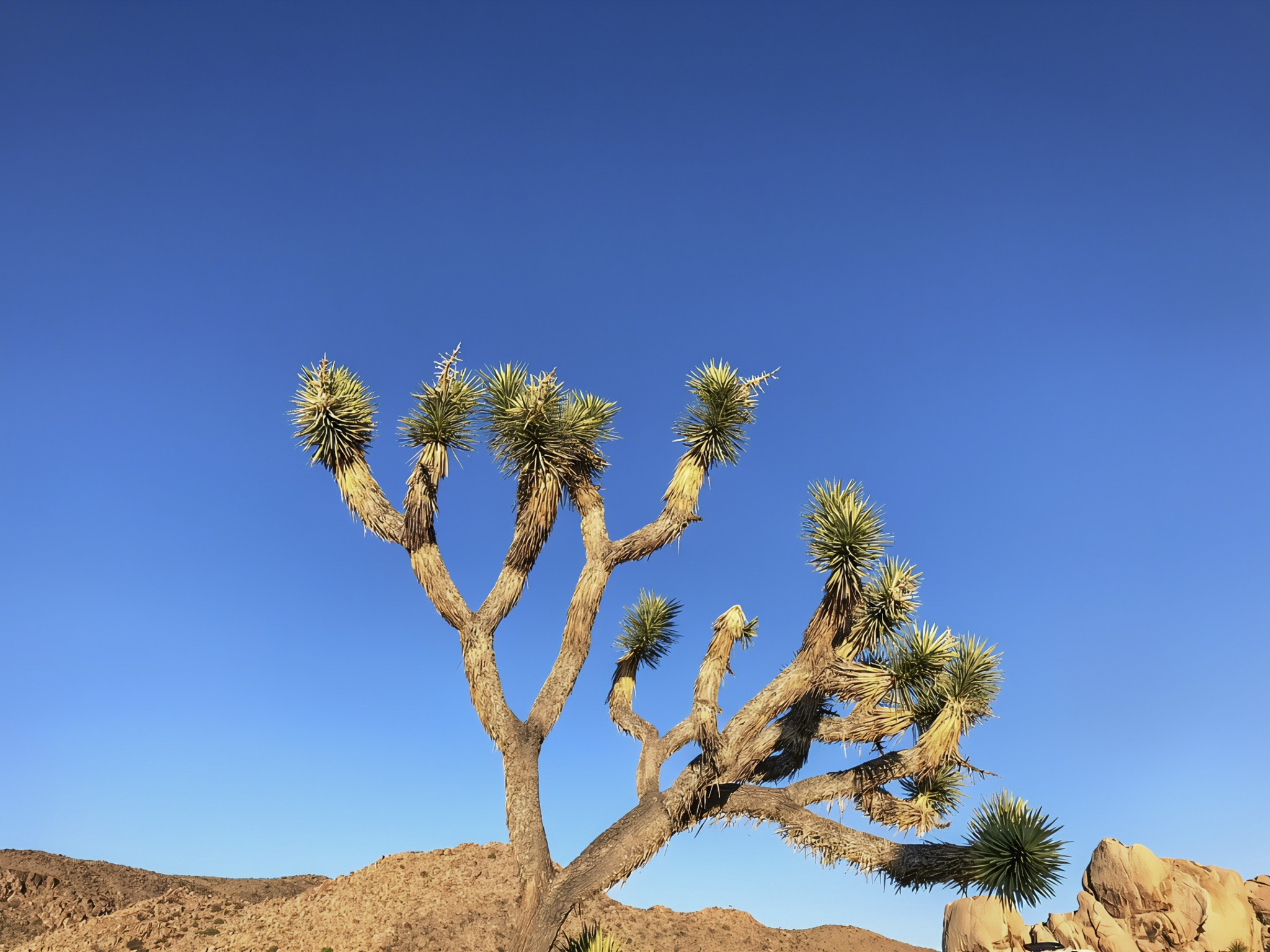

Joshua trees (Yucca brevifolia) are among the most recognizable plants of the Mojave Desert and the namesake of Joshua Tree National Park in Southern California. Despite their name, Joshua trees are not conventional trees but giant, tree-like members of the asparagus family (Asparagaceae), closely related to other yuccas. They are classified as monocots, a group of flowering plants that also includes grasses, palms, and orchids. Joshua trees grow slowly, typically reaching heights of up to 40 feet (12 meters), and many live for approximately 150 years, although some survive for several centuries. Their branching trunks and clusters of stiff, pointed leaves make them particularly distinctive. The National Park Service explains that Indigenous communities historically used Joshua tree leaves for weaving and their flower buds and seeds as food. The common name is traditionally attributed to Mormon settlers, although the historical evidence behind that story remains uncertain (National Park Service [NPS], n.d.-a).
For travelers, Joshua Tree National Park offers opportunities to observe these unusual plants in their natural environment. Joshua trees are most abundant in the park’s higher-elevation Mojave Desert region, especially along Park Boulevard and Keys View Road. Popular areas for viewing them include Hidden Valley, the vicinity of Barker Dam, and the surrounding Joshua tree woodlands. Visitors exploring the northwest portion of the park can encounter extensive stands of mature trees, while the more remote Covington Flat area contains some particularly tall specimens. The park’s southern, lower-elevation Colorado Desert region generally has far fewer Joshua trees because the climate and ecological conditions differ. Spring is especially interesting for nature enthusiasts because favorable rainfall and temperature conditions can trigger clusters of creamy-white flowers. Visitors should remain on designated trails and avoid damaging the trees or disturbing the fragile desert soil around their roots (NPS, n.d.-a, n.d.-b).

Biologically, Joshua trees have developed remarkable adaptations for surviving the Mojave Desert’s dry climate, temperature extremes, and limited rainfall. Their narrow, waxy leaves help reduce water loss, while their extensive root systems allow them to obtain moisture from the surrounding soil. One of their most fascinating biological relationships involves specialized yucca moths (Tegeticula species), which are essential for pollination. Female moths deliberately transfer pollen between flowers while laying their eggs inside them. When the larvae hatch, they consume some developing seeds, leaving others available for reproduction. This relationship is an example of mutualism, in which two species benefit from their association. Joshua trees also provide important habitat for Scott’s orioles, woodrats, desert night lizards, and other wildlife. Another unusual scientific fact is that Joshua trees do not produce conventional annual growth rings, making their ages difficult to determine. Their reproduction and survival depend on suitable environmental conditions, particularly rainfall, temperature, pollinator activity, and the successful establishment of young seedlings (NPS, n.d.-a; U.S. Forest Service, 2025).
Recent scientific research is revealing new information about Joshua tree biology and the challenges these plants face in a changing climate. A study published in New Phytologist investigated an unusual form of water-saving photosynthesis in Joshua trees, providing new insights into how these desert plants regulate carbon uptake and water use (Heyduk et al., 2025). Another study in the California Fish and Wildlife Journal examined western Joshua tree populations in California’s Antelope Valley and discovered that some populations form dense stands through underground stems, with strong winds potentially influencing their growth and branching patterns (White et al., 2026). Meanwhile, researchers at the University of California, Berkeley are developing digital mapping and wildfire-recovery tools to help land managers identify damaged areas and prioritize Joshua tree conservation (Kapoor, 2026). These developments are particularly important because rising temperatures, prolonged drought, invasive grasses, and increasingly destructive wildfires threaten Joshua tree habitats. Together, the research highlights the importance of protecting mature trees, conserving suitable habitats, and understanding how new generations of Joshua trees can survive in the Mojave Desert (Heyduk et al., 2025; White et al., 2026; Kapoor, 2026).


References
Heyduk, K., et al. (2025). Cryptic CAM photosynthesis in Joshua tree (Yucca brevifolia, Y. jaegeriana). New Phytologist, 248(5), 2583–2598. https://doi.org/10.1111/nph.70437
Kapoor, M. L. (2026). With new digital tools, UC Berkeley researchers are helping Joshua trees survive wildfires. University of California, Berkeley.
National Park Service. (n.d.-a). Joshua trees. U.S. Department of the Interior. https://www.nps.gov/jotr/learn/nature/jtrees.htm
National Park Service. (n.d.-b). Frequently asked questions. U.S. Department of the Interior. https://www.nps.gov/jotr/faqs.htm
U.S. Forest Service. (2025). Yucca brevifolia, Yucca jaegeriana, Joshua tree. Fire Effects Information System. https://research.fs.usda.gov/feis/species-reviews/yucspp
White, M. D., Pavliscak, L., & Coleman, M. (2026). Aspects of the population ecology of western Joshua tree in the western Antelope Valley, Mojave Desert, California. California Fish and Wildlife Journal, 112, Article e3. https://doi.org/10.51492/cfwj.112.3
AI Disclosure Statement:
Artificial intelligence tools were used in the creation of this page, including elements such as writing, image enhancement/generation, voice enhancement, and/or editing support. All final creative decisions were made by the creator.


Leave a Reply