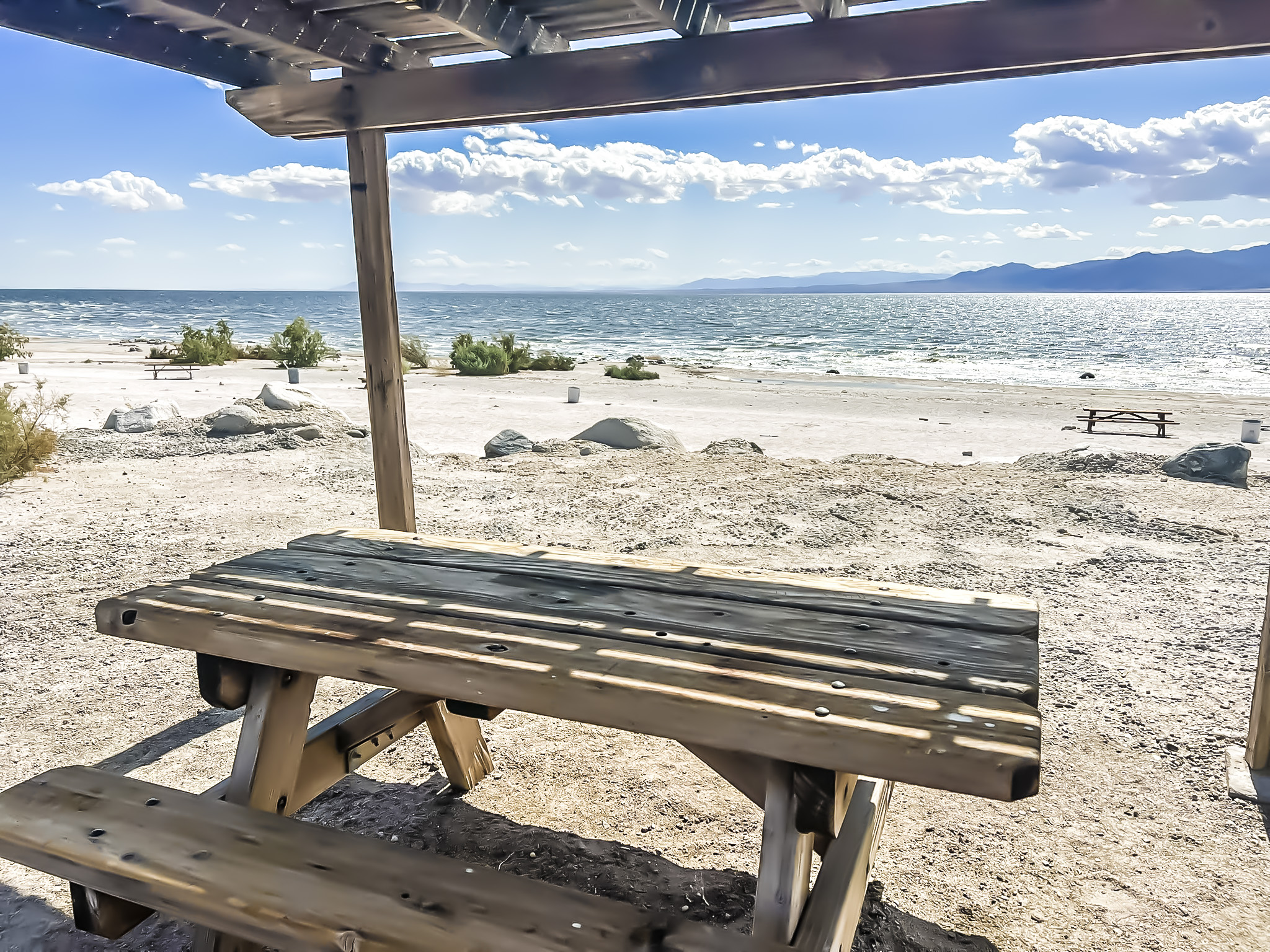

The Salton Sea State Recreation Area protects part of the eastern shoreline of the Salton Sea, California’s largest lake, between the Coachella and Imperial valleys. The modern lake formed when Colorado River floodwater broke through irrigation works and flowed into the below-sea-level Salton Sink. Because the Salton Sea has no natural outlet, water escapes mainly through evaporation, leaving salts and other dissolved substances behind. The lake is now saltier than the ocean, while declining inflows have caused its surface to shrink and expose increasing areas of lakebed (California Department of Parks and Recreation [State Parks], n.d.; California Department of Water Resources [DWR], n.d.).
Travelers visit the recreation area for camping, photography, hiking, kayaking, shoreline exploration, sunsets, and birdwatching, particularly during the cooler months. Developed areas include the main campground and Mecca Beach, although facilities and access can change because of maintenance work and evolving shoreline conditions. Visitors should check the official park website before traveling, carry plenty of drinking water, use sun protection, and wear sturdy footwear. Dogs are permitted in developed areas but are not allowed on beaches or trails (State Parks, n.d.).

Biologically, the Salton Sea is both highly stressed and exceptionally important. Its location along the Pacific Flyway makes the lake, surrounding wetlands, and nearby agricultural fields valuable feeding and resting habitat for pelicans, cormorants, herons, egrets, gulls, American avocets, black-necked stilts, and numerous migratory waterfowl. Increasing salinity, oxygen depletion, shrinking wetlands, and periodic fish die-offs have transformed the food web, while exposed lakebed creates dust concerns for surrounding communities. Nevertheless, salt-tolerant microorganisms continue to drive sulfur and nutrient cycling, while the nearby desert supports reptiles, small mammals, coyotes, and other wildlife adapted to extreme heat and limited rainfall (DWR, n.d.; Freund et al., 2025).
Recent research is revealing how this unusual ecosystem functions as environmental conditions change. Scientists found that the Salton Sea’s microbial community varies significantly by season, with temperature, dissolved organic matter, and oxygen helping determine which organisms dominate; sulfur-cycling genes were detected throughout the water column, demonstrating how salt-tolerant microbes influence the lake’s chemistry and possibly its sulfur odors (Freund et al., 2025). Other researchers have examined trends in bird populations and habitats as the lake contracts, emphasizing the importance of long-term monitoring and habitat restoration (Orr et al., 2026). These findings are helping scientists and resource managers evaluate projects designed to control dust, restore wetlands, and protect wildlife and public health.


References:
California Department of Parks and Recreation. (n.d.). Salton Sea State Recreation Area. https://www.parks.ca.gov/?page_id=639
California Department of Water Resources. (n.d.). Salton Sea Unit. https://water.ca.gov/Programs/Integrated-Regional-Water-Management/Salton-Sea-Unit
Freund, L., Hung, C., Topacio, T. M., Diamond, C., Fresquez, A., Lyons, T. W., & Aronson, E. L. (2025). Diversity of sulfur cycling halophiles within the Salton Sea, California’s largest lake. BMC Microbiology, 25. https://doi.org/10.1186/s12866-025-03839-2
Orr, D., Bonis-Ericksen, K., Bautista, C., & Jones, A. (2026). A shrinking inland sea: Trends in avian populations and habitats at the Salton Sea. Waterbirds, 48(3). https://doi.org/10.1675/063.048.0311
AI Disclosure Statement:
Artificial intelligence tools were used in the creation of this page, including elements such as writing, image enhancement, voice enhancement, and/or editing support. All final creative decisions were made by the creator.


Leave a Reply