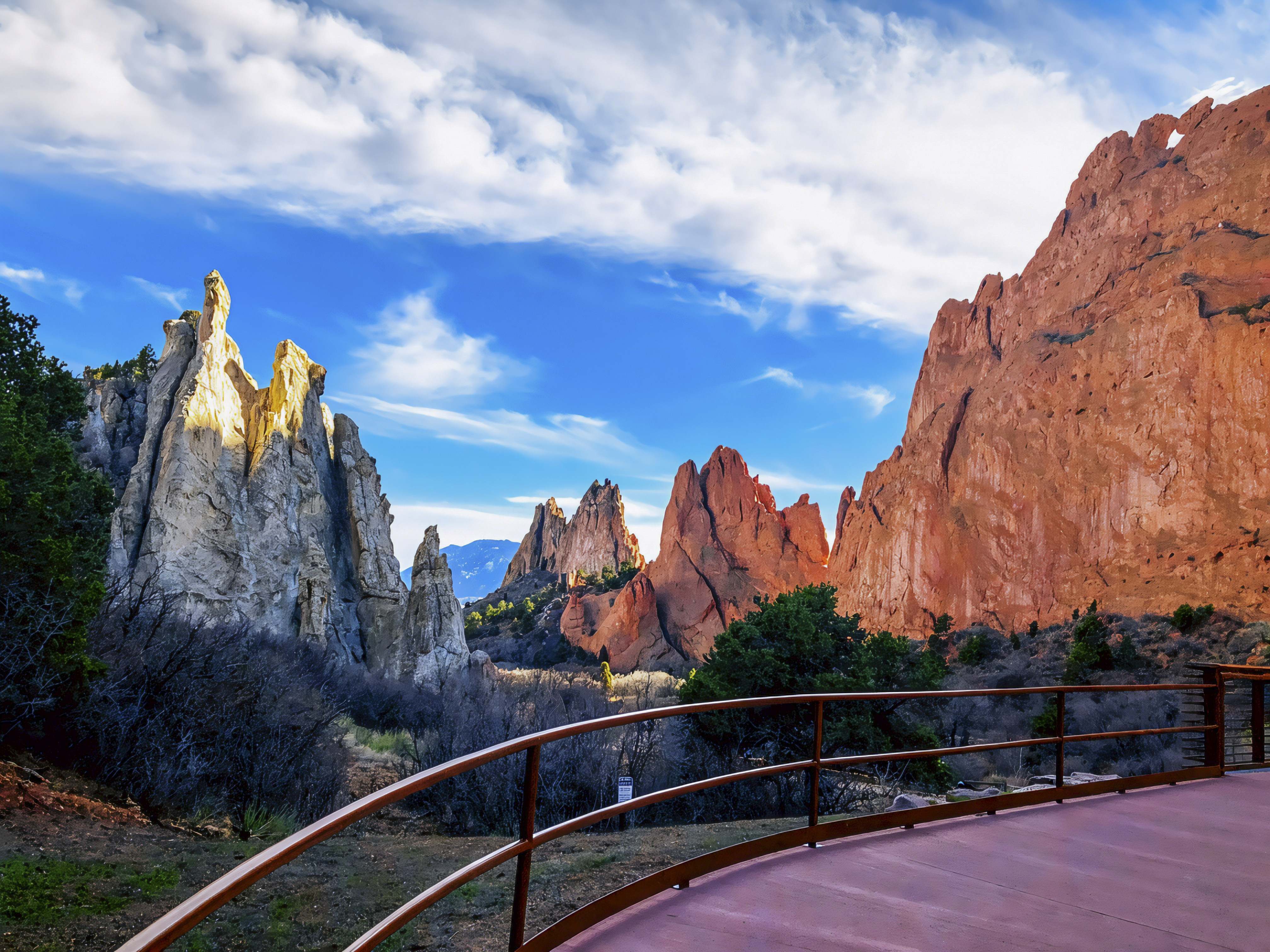

Garden of the Gods is a free public park in Colorado Springs where travelers can explore remarkable geology without venturing far from the city. Recognized as a National Natural Landmark, it offers walking trails, views toward Pikes Peak, and a Visitor & Nature Center with exhibits about the landscape’s natural history. The area also has a long human history: the Ute people have deep ancestral connections to the land, and Camp Creek Valley provided water, plants, and shelter. The park’s modern preservation story centers on railroad businessman Charles Elliott Perkins, whose children donated his property to Colorado Springs with the condition that it remain free for public enjoyment (City of Colorado Springs, n.d.; Garden of the Gods Visitor & Nature Center, n.d.).
For visitors, the Central Garden’s paved pathways provide an approachable introduction, while additional trails offer longer walks and opportunities for biking or horseback riding in designated areas. Popular stops include Balanced Rock and the Siamese Twins, where an opening in the rock provides a distinctive view toward Pikes Peak. Starting at the Visitor & Nature Center helps travelers choose a route and understand what they will encounter. Bring water, wear layers for changing weather, and remain on established trails to protect sensitive vegetation. Technical climbing requires appropriate equipment and a permit, and climbers should check seasonal route closures before visiting (City of Colorado Springs, n.d.).

The park’s geology records a landscape that changed from eroding mountains to sandy deserts and marine environments. The Fountain Formation developed from gravel, sand, and mud carried away from the ancestral Rocky Mountains, while the Lyons Sandstone preserves deposits from ancient dunes. Iron oxides help explain the reddish coloration of many formations. Later mountain building fractured and tilted originally horizontal layers, and weathering and erosion gradually exposed the rock fins seen today (City of Colorado Springs, 2020–2021). Recent related research adds another chapter: a study published in Gondwana Research examined Colorado’s Lykins Formation, which also occurs in the park. Chemical evidence indicated a shallow setting connected to marine waters, where microbial structures called stromatolites were abundant but animal fossils were scarce. The researchers linked this pattern to difficult environmental conditions and investigated its relationship to the end-Permian mass extinction, although the extinction’s exact position within the formation remains uncertain. This was a regional study, with geochemical sampling chiefly from northern Colorado drill cores, rather than a discovery confined to Garden of the Gods (Zawaski et al., 2026).
Living nature is equally rewarding here because the park brings together six ecosystems: prairie grasslands, wetlands, mountain shrublands, piñon-juniper woodlands, cliff habitats, and montane forests. These environments support plants ranging from prickly-pear cactus and yucca to cottonwoods and ponderosa pines. Wildlife includes mule deer, coyotes, bighorn sheep, and numerous birds; white-throated swifts and prairie falcons are associated with the rocky cliffs, while red-winged blackbirds occur around wetter habitats. For science-minded travelers, this variety offers a practical lesson in ecology: differences in water, soils, elevation, and rock surfaces help determine which organisms can live in each part of the park. Watching quietly from established paths allows visitors to appreciate these connections while limiting disturbance (City of Colorado Springs, 2023–2024).


References
- City of Colorado Springs. (n.d.). Garden of the Gods. https://coloradosprings.gov/gog
- City of Colorado Springs. (2020–2021). Geology of the park program: Teacher reference guide. Read the educational guide.
- City of Colorado Springs. (2023–2024). Garden of the Gods: Teacher reference guide. Read the ecology and history guide.
- Garden of the Gods Visitor & Nature Center. (n.d.). Garden of the Gods park history. https://gardenofgods.com/park-history
- Zawaski, M. J., Hagadorn, J. W., Whiteley, K. R., Longman, M., Yusas, M., Lahey, B. L., Phillips, A. A., Algeo, T. J., Shen, J., Haas, J., Liu, Z., & Mojzsis, S. J. (2026). Tracing paleoenvironmental change across the Permian-Triassic transition in Colorado. Gondwana Research, 153, 150–169. https://doi.org/10.1016/j.gr.2025.11.010
AI Disclosure Statement:
Artificial intelligence tools were used in the creation of this page, including elements such as writing, image enhancement/generation, voice enhancement, and/or editing support. All final creative decisions were made by the creator.

Leave a Reply