

Newspaper Rock overlook in Petrified Forest National Park, Arizona, offers a fascinating connection between Indigenous history and the desert landscape. More than 650 petroglyphs cover rock surfaces below the overlook, preserving carvings made by ancestral Puebloan people who lived, farmed, and hunted along the nearby Puerco River. These markings accumulated over many generations, and some artists may have lived at nearby Puerco Pueblo. Despite the name, Newspaper Rock does not present a single readable story. Indigenous interpretations include clan symbols, spiritual meanings, migration routes, and calendar events, highlighting the site’s continuing cultural significance (National Park Service [NPS], 2018).
For travelers, the turnoff to Newspaper Rock is about 12 miles from the park’s north entrance, making it a convenient stop along the main scenic drive. A spur road leads to parking, and a path accessible to mobility devices reaches the overlook. Free spotting scopes help visitors examine the petroglyphs on the boulders below; binoculars or a camera with a zoom lens can also be useful. Take time to explore the interpretive exhibits and look across the surrounding rocky terrain and open grassland. Visitors must remain at the designated viewing area because unstable slopes prevent access to the carvings. A partial cliff collapse led to the closure of the former trail and the establishment of the present overlook (NPS, 2021).

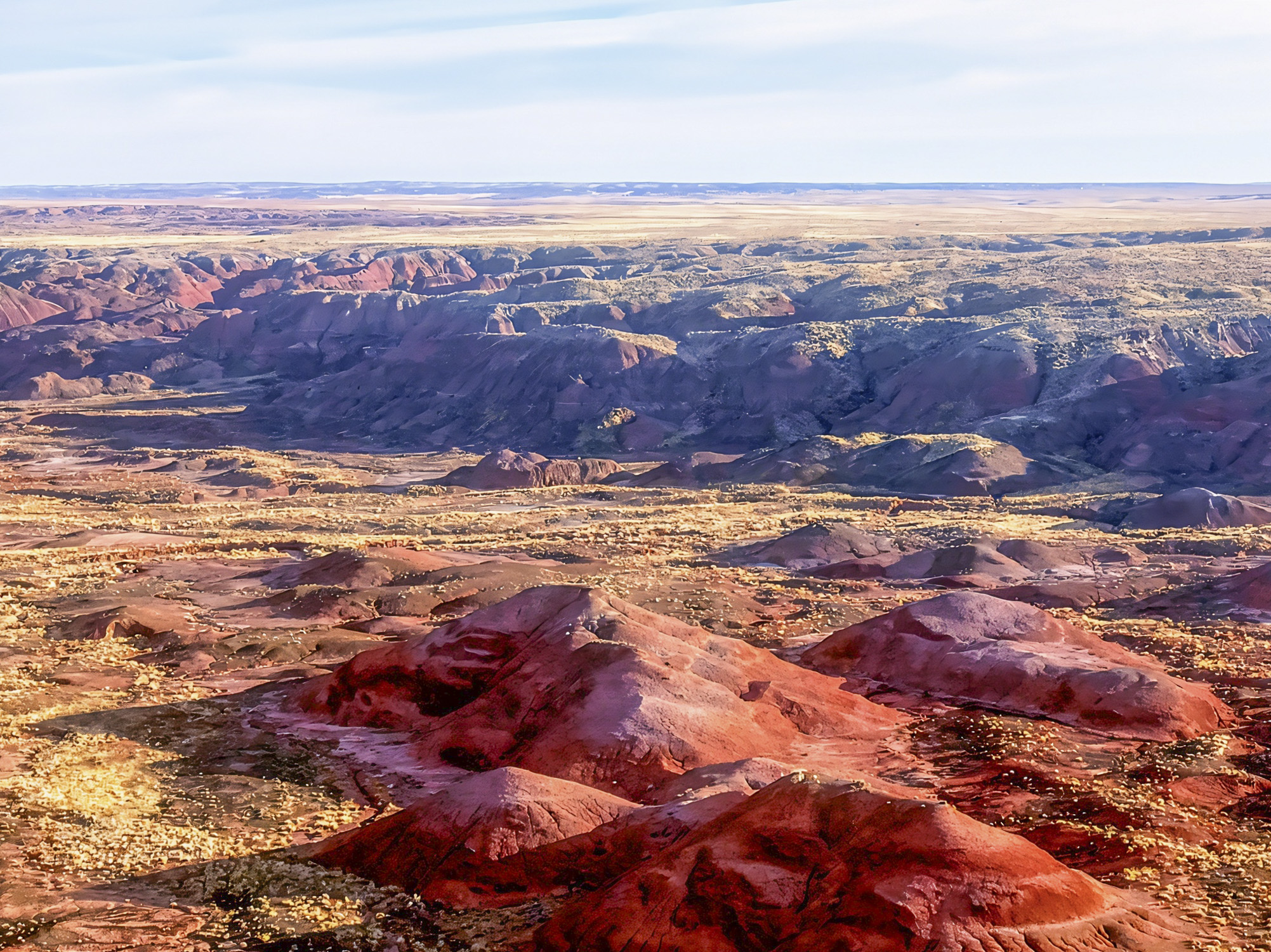
The geology adds a much older chapter to the experience. Newspaper Rock Sandstone is a prominent sandstone bed within the Blue Mesa Member of the Chinle Formation, which records river and floodplain environments from the Late Triassic, more than 200 million years ago. These sedimentary rocks preserve evidence of a landscape very different from today’s dry grasslands (NPS, 2020). The dark coating on the rock surfaces, called desert varnish, contains clay minerals and compounds of iron and manganese. Ancient artists pecked through this coating to expose lighter stone beneath, creating the contrast that makes the petroglyphs visible. Here, the properties of the rock helped provide a durable surface for cultural expression (NPS, 2018).
The surrounding landscape also supports a living ecosystem adapted to limited water and changing temperatures. Across the park, grasses, shrubs, cacti, and seasonal wildflowers provide habitat and resources for animals. Some plants survive dry periods through dormancy, while others reduce water loss through features such as small or hairy leaves (NPS, 2025b). Birds, lizards, and rabbits are among the animals visitors most frequently encounter, although sightings at the overlook depend on weather and season. Many animals avoid summer heat by becoming active around dawn, dusk, or at night. Watching quietly from the designated path offers an opportunity to appreciate these survival strategies while leaving wildlife undisturbed (NPS, 2025a).


References
National Park Service. (2018). Newspaper Rock. https://www.nps.gov/pefo/learn/historyculture/newspaper-rock.htm
National Park Service. (2020). Geologic formations. https://www.nps.gov/pefo/learn/nature/geologicformations.htm
National Park Service. (2021). Newspaper Rock. https://www.nps.gov/places/newspaper-rock.htm
National Park Service. (2025a). Animals. https://www.nps.gov/pefo/learn/nature/animals.htm
National Park Service. (2025b). Plants. https://www.nps.gov/pefo/learn/nature/plants.htm
AI Disclosure Statement:
Artificial intelligence tools were used in the creation of this page, including elements such as writing, image enhancement/generation, voice enhancement, and/or editing support. All final creative decisions were made by the creator.

Leave a Reply