
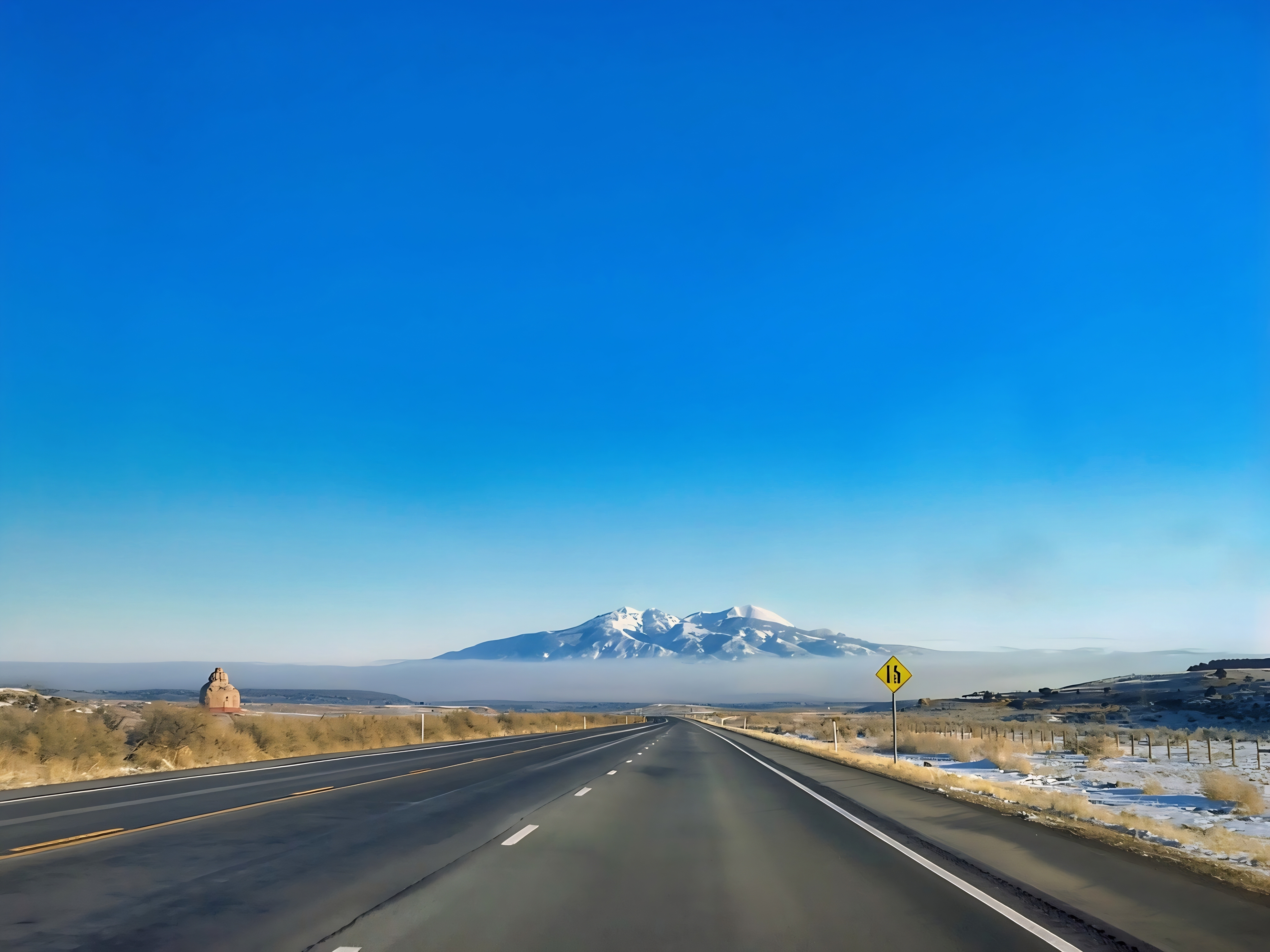
The drive to Mount Charleston begins on NV-157, or Kyle Canyon Road, about 35 miles northwest of Las Vegas, climbing from open Mojave Desert terrain into the cooler forests of the Spring Mountains National Recreation Area. As the highway gains elevation, expansive desert views, pale limestone cliffs, and scattered Joshua trees gradually give way to pinyon-juniper woodland and tall ponderosa pines near the Mount Charleston community. From Kyle Canyon, NV-158—also called Deer Creek Road—winds northward across forested mountain slopes toward Lee Canyon, where travelers can stop at the Desert View Overlook near NV-156 for broad views across the surrounding desert and mountain landscape. The return trip east along NV-156, or Lee Canyon Road, continues through changing vegetation zones before descending toward the Mojave Desert and U.S. Route 95 (U.S. Forest Service [USFS], n.d.).
For science-minded travelers, this loop offers a vivid example of how elevation shapes biological communities: desert scrub at lower elevations transitions into Joshua tree habitat, pinyon-juniper woodland, mixed conifer forest, and—near the highest summits—bristlecone pine and sparse alpine vegetation (U.S. Geological Survey [USGS], 2024). Mule deer may be seen near meadows or forest edges, while smaller residents include birds, squirrels, and the Palmer’s chipmunk, a species found only in the Spring Mountains whose distribution is strongly associated with forest type, slope, and proximity to water (Lowrey et al., 2016). Drivers should watch carefully for wildlife, changing weather, sharp curves, and occasional cyclists; in winter, snow chains or four-wheel drive may be required, roadside parking is restricted in many places, and cellular coverage is limited, so visitors should check road conditions before departure (Nevada Department of Transportation [NDOT], n.d.).
References:
Lowrey, C. E., Longshore, K. M., Riddle, B. R., & Mantooth, S. J. (2016). Ecology, distribution, and predictive occurrence modeling of Palmer’s chipmunk (Tamias palmeri): A high-elevation small mammal endemic to the Spring Mountains in southern Nevada, USA. Journal of Mammalogy, 97(4), 1033–1043.
Nevada Department of Transportation. (n.d.). Mt. Charleston winter safety.
U.S. Forest Service. (n.d.). Spring Mountains recreation guide and area map.
U.S. Geological Survey. (2024). Ungulate migrations of the Western United States, volume 4. Scientific Investigations Report 2024–5006.
AI Disclosure Statement:
Artificial intelligence tools were used in the creation of this page, including elements such as writing, image enhancement, voice enhancement, and/or editing support. All final creative decisions were made by the creator.


Leave a Reply