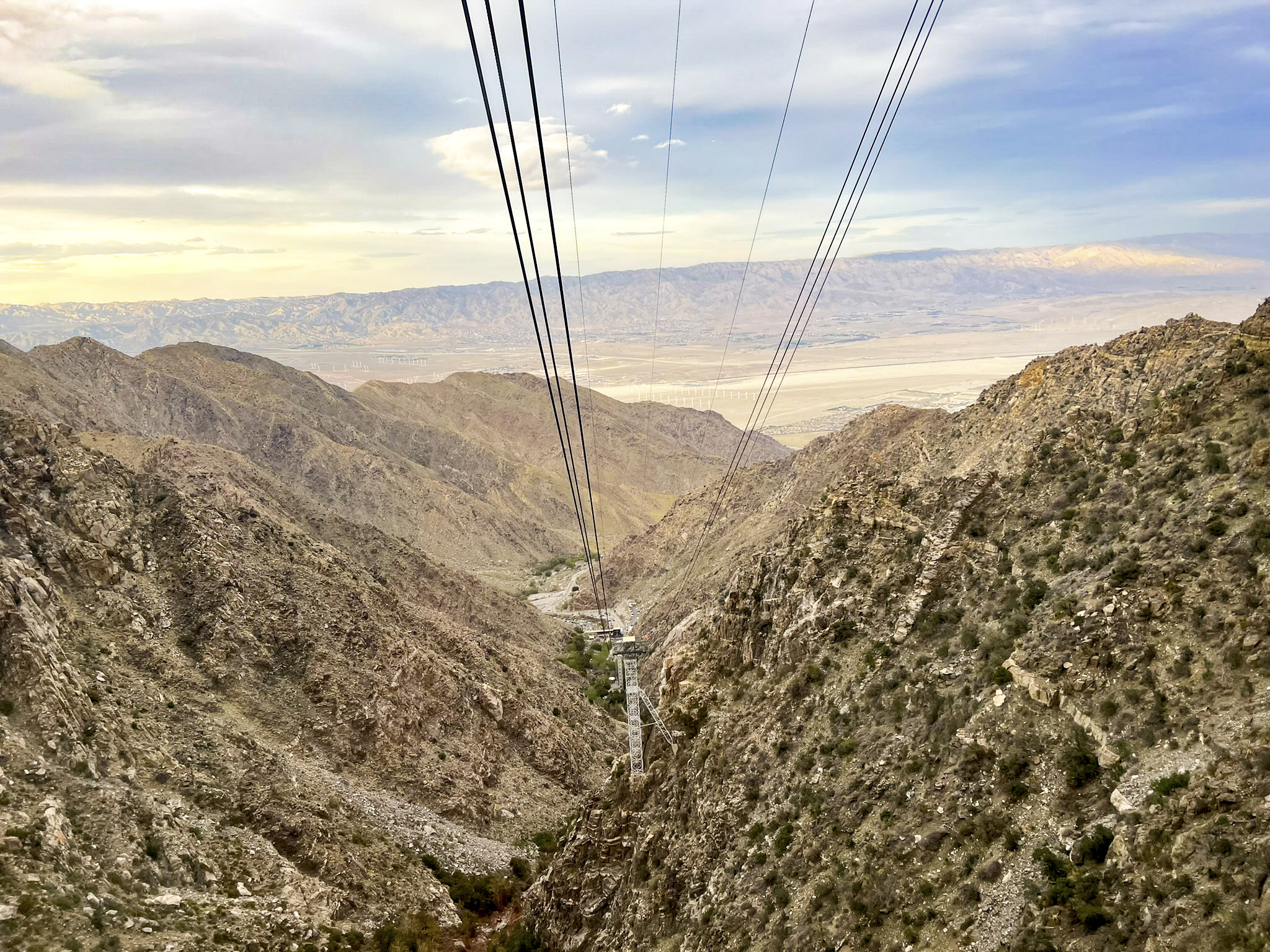

The Palm Springs Aerial Tramway offers a dramatic journey from the Sonoran Desert into the cool forests of Mount San Jacinto State Park. During the approximately 10-minute, 2.5-mile ride, the tram climbs from Valley Station at 2,643 feet to Mountain Station at 8,516 feet. The attraction opened in 1963 after an ambitious construction project that required roughly 23,000 helicopter flights to carry workers and materials into rugged Chino Canyon. Since 2000, visitors have traveled aboard large rotating tramcars that provide continuously changing views during the ascent (Palm Springs Aerial Tramway, 2025).
Before visiting, travelers should check current forecasts, current operating hours, ticket availability, and the tramway’s live mountain camera. Temperatures at Mountain Station are often 30–40°F cooler than in Palm Springs, and snow or ice may be present from late autumn through spring, so layered clothing and sturdy footwear are advisable (Palm Springs Aerial Tramway, 2026a). At the top, visitors will find observation decks, restaurants, a lounge, theaters, a natural-history museum, picnic areas, and access to more than 50 miles of trails. Popular choices include the easy 0.75-mile Long Valley Discovery Trail, the moderately strenuous 1.5-mile Desert View Trail, and the much more challenging route to 10,834-foot San Jacinto Peak. Wilderness permits are required when traveling beyond the immediate Long Valley trail system (Palm Springs Aerial Tramway, 2026b).

Mount San Jacinto’s steep cliffs, exposed granite, boulder fields, mountain meadows, and deeply carved canyons reflect a long history of tectonic uplift and erosion. The rapid elevation change creates an equally striking biological transition—from desert scrub around the lower station to forests of Jeffrey pine, white fir, incense cedar, lodgepole pine, and other high-elevation conifers. Wildlife may include mule deer, western gray squirrels, chipmunks, Steller’s jays, mountain chickadees, woodpeckers, reptiles, and numerous insects. Remote waterways elsewhere in the San Jacinto Mountains also support the endangered mountain yellow-legged frog, although visitors are unlikely to encounter this sensitive species near the developed tramway area (California Department of Parks and Recreation, n.d.; U.S. Fish and Wildlife Service, 2022).
Recent scientific work continues to reveal the ecological importance of this mountaintop environment. A 2026 study investigated moss and lichen diversity around the upper Palm Springs Aerial Tramway, drawing attention to small organisms that contribute to moisture retention, nutrient cycling, soil formation, and habitat complexity (Paulsen et al., 2026). In another recent study, researchers documented mating behavior among endangered mountain yellow-legged frogs in the San Jacinto Mountains, providing useful information about their reproductive timing and conservation needs (Curtis et al., 2025). These studies demonstrate that Mount San Jacinto is not only a spectacular travel destination but also a valuable natural laboratory for examining how elevation, climate, geology, and isolation shape biological diversity.


References:
California Department of Parks and Recreation. (n.d.). Mount San Jacinto State Park. https://www.parks.ca.gov/?page_id=636
Curtis, M. J., Janik, D. K., Hammond, T. T., & Shier, D. M. (2025). Observations of amplexus in mountain yellow-legged frogs (Rana muscosa) in the San Jacinto Mountains. Reptiles & Amphibians, 32(1), Article e21962. https://doi.org/10.17161/randa.v32i1.21962
Palm Springs Aerial Tramway. (2025). History. https://pstramway.com/history/
Palm Springs Aerial Tramway. (2026a). About us. https://pstramway.com/about-us/
Palm Springs Aerial Tramway. (2026b). Hiking. https://pstramway.com/hiking/
Paulsen, J., Hillegass, K., Herath, H. K., & Bauer, J. (2026). Above the desert: Bryological and lichenological diversity at the summit of Palm Springs Aerial Tramway, Mount San Jacinto, California. Evansia, 43(1). https://doi.org/10.1639/0747-9859-43.1.34
U.S. Fish and Wildlife Service. (2022). Mountain yellow-legged frog (Rana muscosa). https://www.fws.gov/species/mountain-yellow-legged-frog-rana-muscosa
AI Disclosure Statement:
Artificial intelligence tools were used in the creation of this page, including elements such as writing, image enhancement, voice enhancement, and/or editing support. All final creative decisions were made by the creator.


Leave a Reply