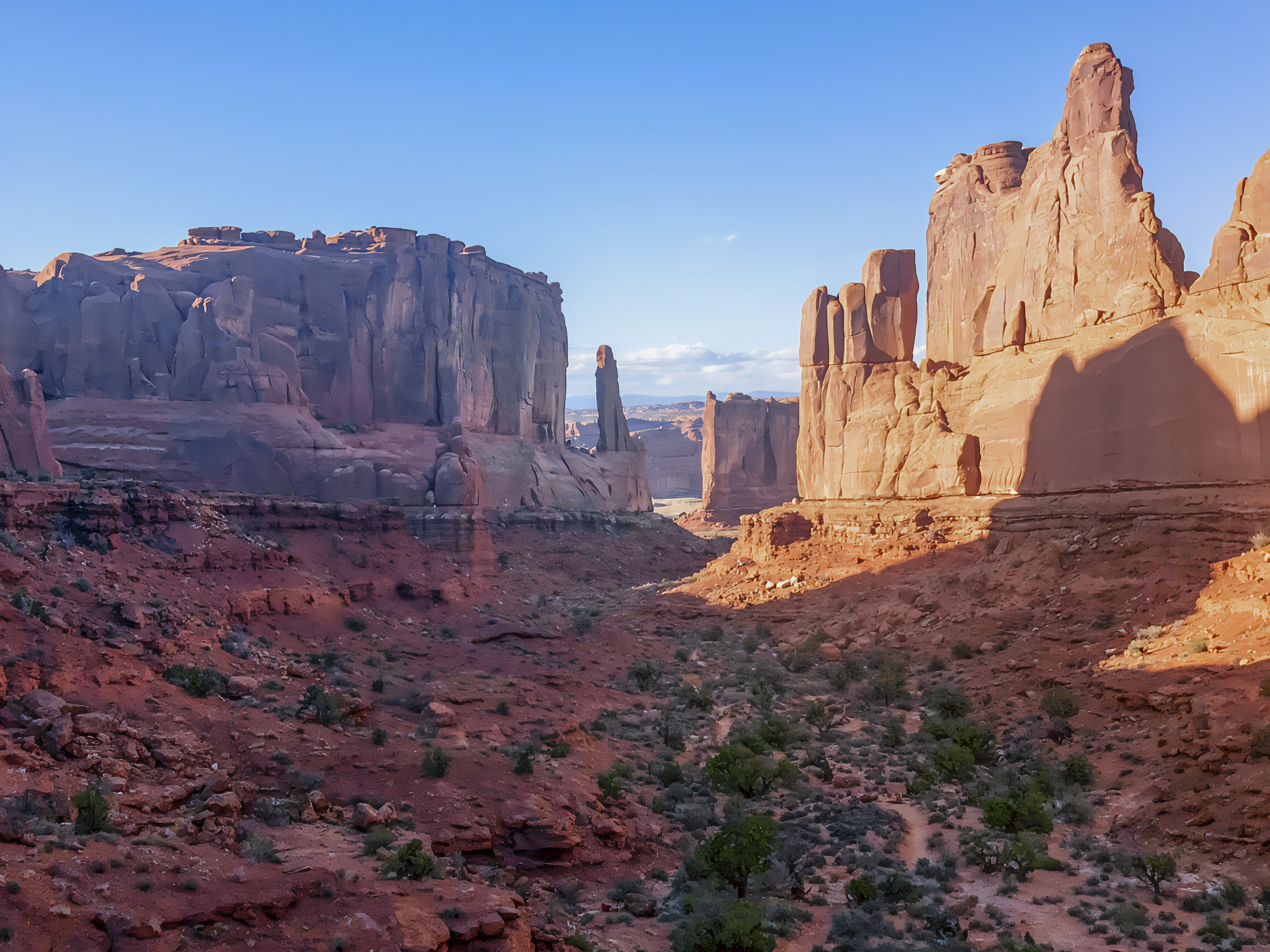

The drive from the entrance of Arches National Park to Park Avenue Viewpoint introduces travelers to southeastern Utah’s desert scenery before they reach the park’s famous arches. Near Moab, this protected landscape contains more than 2,000 natural stone arches, along with immense rock walls, slender pinnacles, and balanced formations. Our route passed the entrance sign, climbed winding roads beneath rugged cliffs, and included a roadside stop with views toward the snow-covered La Sal Mountains. Continuing to Park Avenue brought us to a canyon bordered by towering formations resembling a skyline of stone buildings. For visitors planning a similar trip, carrying water, using sun protection, downloading maps, and checking current entrance conditions are essential preparations because shade and cellular service are limited (National Park Service [NPS], 2026a).
Park Avenue offers an impressive introduction to the park without requiring a long hike. A paved, wheelchair-accessible walkway leads to the overlook, while stairs beyond it descend into a canyon where the trail continues toward Courthouse Towers. Travelers who follow the canyon route should expect sand, uneven rock, and an uphill return to the starting viewpoint. The massive walls and narrow towers invite imaginative comparisons: earlier visitors gave nearby formations names such as Queen Nefertiti, Queen Victoria, and Sausage Rock. Another surprising feature is Park Avenue Arch, which can be seen high on a rock wall from the parking area, although its opening does not reveal daylight from that angle. These details make the stop rewarding for both casual sightseers and hikers interested in looking more closely at the landscape (NPS, 2025c).

The cliffs along this journey reveal a landscape shaped by buried salt, ancient sand deposits, uplift, and erosion. Much of the park’s sculpted scenery involves Entrada Sandstone, formed from sand deposited in an ancient desert. Deep underground, salt shifted under the weight of overlying rock, bending the layers above and helping create fractures. As erosion exposed the sandstone, water entered those cracks, gradually weakening the rock and separating it into narrow walls called fins. Some fins eventually developed openings that became arches. Rainwater can dissolve minerals binding sand grains together, while freezing water can widen cracks and loosen fragments. The fractures, recessed surfaces, and fallen boulders encountered along the entrance road and at Park Avenue are reminders that this process continues today. Despite the dry setting, water is a major sculptor of the park’s terrain (NPS, 2025b).
The shrubs and small trees around the viewpoints also reveal a living desert ecosystem. Across Arches, blackbrush occupies shallow sandy soils, while pinyon and juniper grow in rocky ground; wildlife includes lizards, small mammals, mule deer, and coyotes, with many species avoiding daytime heat (NPS, 2025a, 2025d). Between plants, biological soil crusts containing cyanobacteria, lichens, mosses, and other organisms help stabilize soil and support fertility, adding an ecological reason to remain on established trails (U.S. Geological Survey, 2026). Recent research highlighted by the National Park Service adds another dimension to this trip: scientists analyzed two decades of satellite imagery and climate data and found that vegetation growth generally increased over the study period, while growing seasons lengthened. However, responses differed among plant communities, and rainfall from preceding years influenced later growth. Blackbrush and certain grasslands were comparatively vulnerable to drought, showing why increased greenness alone does not mean every part of the desert is becoming healthier (NPS, 2026b).


References
National Park Service. (2025a). Animals. https://www.nps.gov/arch/learn/nature/animals.htm
National Park Service. (2025b). Geologic formations. https://www.nps.gov/arch/learn/nature/geologicformations.htm
National Park Service. (2025c). Park Avenue viewpoint and trail. https://www.nps.gov/places/park-avenue-viewpoint-and-trailhead.htm
National Park Service. (2025d). Plants. https://www.nps.gov/arch/learn/nature/plants.htm
National Park Service. (2026a). Plan your visit. https://www.nps.gov/arch/planyourvisit/index.htm
National Park Service. (2026b). Vegetation production and phenology at Arches National Park, 2000–2019. https://www.nps.gov/articles/000/ncpn-vegetation-production-phenology-arches.htm
U.S. Geological Survey. (2026). Biological soil crust (“biocrust”) science. https://www.usgs.gov/centers/southwest-biological-science-center/science/biological-soil-crust-biocrust-science
AI Disclosure Statement:
Artificial intelligence tools were used in the creation of this page, including elements such as writing, image enhancement/generation, voice enhancement, and/or editing support. All final creative decisions were made by the creator.


Leave a Reply