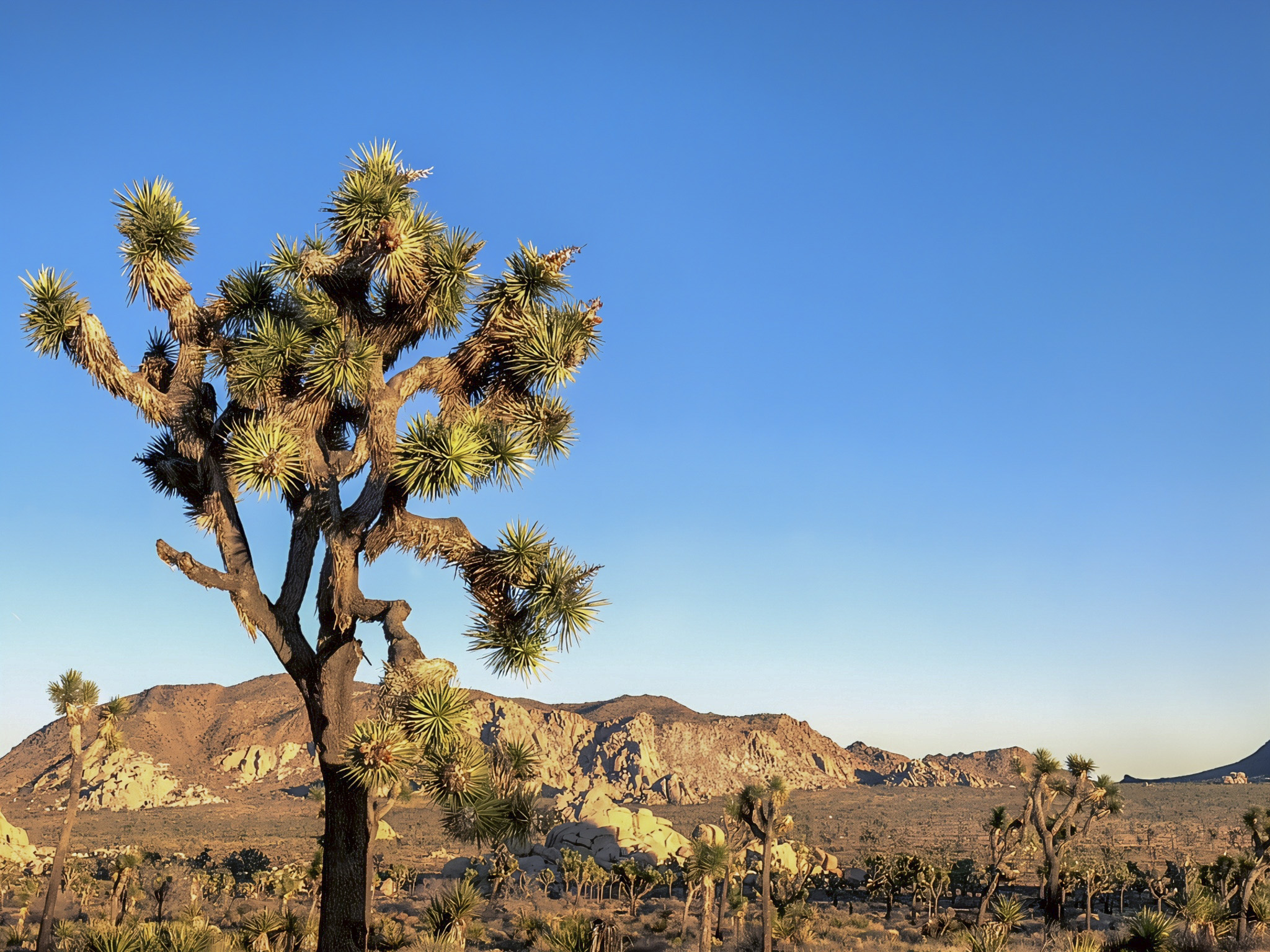

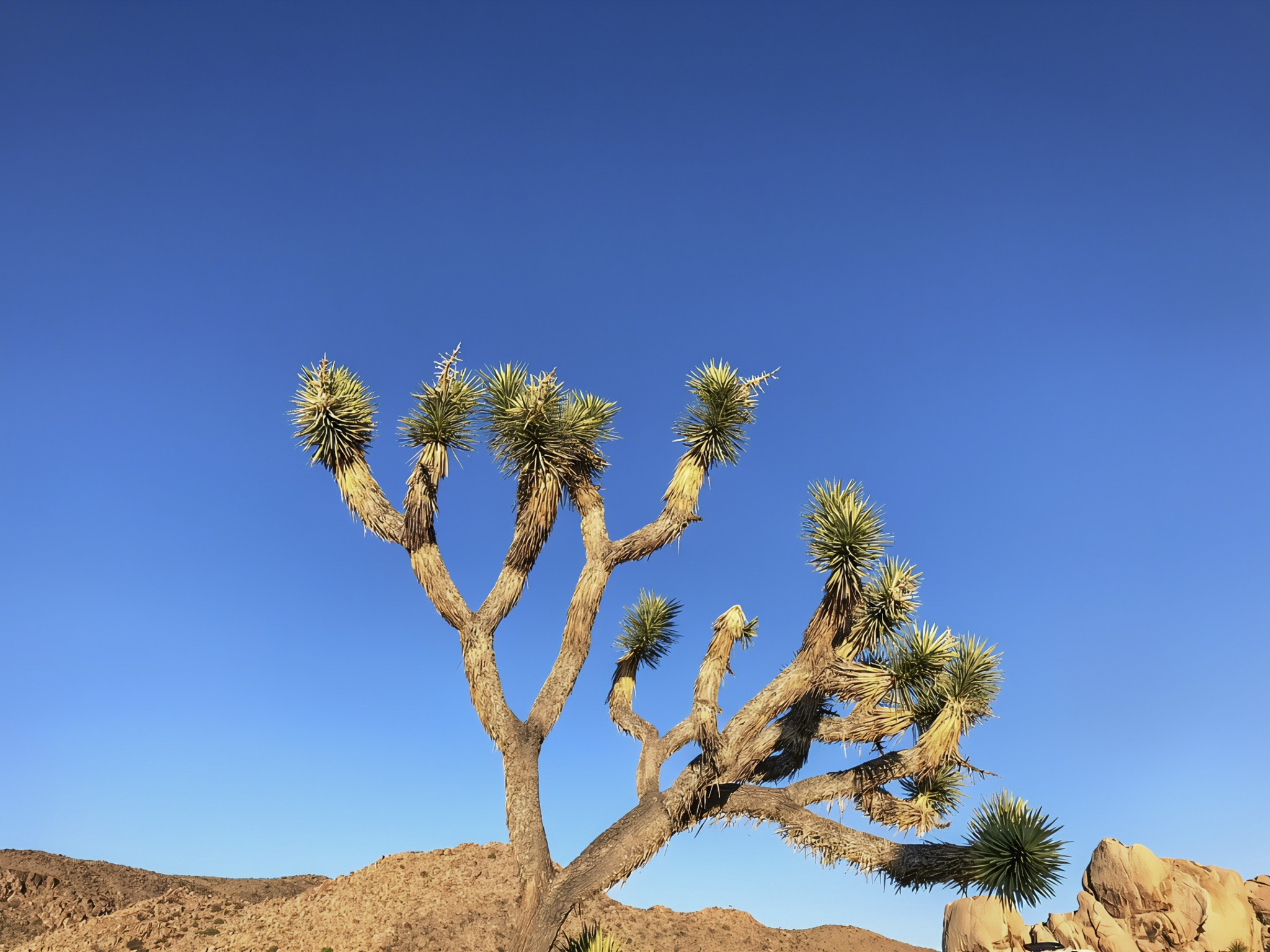
Located in Southern California, Joshua Tree National Park is a remarkable desert wilderness where the Mojave and Colorado deserts meet, creating a unique landscape filled with unusual plants, rugged mountains, and spectacular rock formations. Covering nearly 800,000 acres, the park protects two distinct desert environments, each with its own climate, vegetation, and wildlife. The higher and cooler Mojave Desert is famous for its Joshua trees (Yucca brevifolia), while the lower and warmer Colorado Desert features creosote bushes, ocotillos, and various cactus species. The park also protects a rich cultural history, including evidence of Indigenous communities, historic mining activities, and early desert settlements. Its unusual landscapes, clear night skies, and remarkable biodiversity make it a popular destination for travelers, photographers, hikers, and nature enthusiasts (National Park Service [NPS], n.d.-a).
Visitors to Joshua Tree National Park can explore numerous scenic destinations through hiking, sightseeing, camping, rock climbing, and wildlife observation. Popular attractions include Hidden Valley Nature Trail, where a relatively short loop passes through a landscape of enormous boulders and desert vegetation; Barker Dam, which offers opportunities to observe wildlife and learn about the area’s ranching history; and Skull Rock, a naturally weathered rock formation resembling a human skull. The Cholla Cactus Garden provides an impressive concentration of teddy bear cholla (Cylindropuntia bigelovii), while Arch Rock and the nearby Heart Rock attract visitors interested in unusual geological formations. Keys View offers expansive views of the Coachella Valley, surrounding mountains, and the San Andreas Fault region. Cooler months generally provide more comfortable hiking conditions, while spring may bring colorful wildflower displays when rainfall is favorable. Travelers should carry plenty of drinking water, sun protection, and navigation supplies because services, water sources, and cellular reception are limited inside the park (NPS, n.d.-b, n.d.-c).

Geologically, Joshua Tree National Park reveals a fascinating history of underground magma, tectonic movements, weathering, and erosion. Many of its enormous rounded boulders consist of monzogranite, an intrusive igneous rock formed when molten material slowly cooled beneath Earth’s surface more than 100 million years ago. Over millions of years, tectonic forces fractured these rocks, while chemical weathering and erosion gradually exposed and rounded the massive formations visible today. These geological processes produced the spectacular stacked boulders, narrow passages, natural arches, and rocky hills found throughout the park. The landscape also contains metamorphic rocks, alluvial fans, dry washes, and fault systems associated with the tectonically active region of Southern California. Areas such as Jumbo Rocks, Hidden Valley, and the White Tank region provide excellent opportunities to observe how geological processes shape desert landscapes over immense periods of time (NPS, n.d.-d).
Biologically, Joshua Tree National Park supports an impressive diversity of desert-adapted organisms, including hundreds of plant species, desert bighorn sheep, coyotes, black-tailed jackrabbits, reptiles, migratory birds, and numerous insects. Joshua trees are especially important because they provide nesting sites, shelter, and food resources for various desert animals. Their reproduction also involves a remarkable relationship with specialized yucca moths, which pollinate the flowers while using them as sites for laying eggs. However, recent scientific research and conservation efforts highlight growing threats from climate change, prolonged drought, invasive grasses, and wildfires. Research reported by the University of California, Berkeley describes new computer-based tools that help scientists and park managers evaluate wildfire damage and identify promising locations for Joshua tree restoration. Meanwhile, the National Park Service is experimenting with nursery-grown seedlings, direct seeding, and protective cages around young plants to improve survival in burned areas. These efforts are particularly important because rising temperatures and changing rainfall patterns may reduce suitable habitat for Joshua trees, threatening an ecological community that has developed over thousands of years. Protecting the park therefore requires not only preserving its landscapes but also understanding the ecological relationships and environmental changes shaping its future (NPS, 2025; Kapoor, 2026; NPS, n.d.-e).


References
Kapoor, M. L. (2026). With new digital tools, UC Berkeley researchers are helping Joshua trees survive wildfires. Berkeley News, University of California, Berkeley. https://news.berkeley.edu/2026/08/05/with-new-digital-tools-uc-berkeley-researchers-are-helping-joshua-trees-survive-wildfires/
National Park Service. (n.d.-a). Nature—Joshua Tree National Park. U.S. Department of the Interior. https://www.nps.gov/jotr/learn/nature/index.htm
National Park Service. (n.d.-b). Things to do—Joshua Tree National Park. U.S. Department of the Interior. https://www.nps.gov/jotr/planyourvisit/things2do.htm
National Park Service. (n.d.-c). Basic information—Joshua Tree National Park. U.S. Department of the Interior. https://www.nps.gov/jotr/planyourvisit/basicinfo.htm
National Park Service. (n.d.-d). Geologic formations—Joshua Tree National Park. U.S. Department of the Interior. https://www.nps.gov/jotr/learn/nature/geologicformations.htm
National Park Service. (n.d.-e). Climate change—Joshua Tree National Park. U.S. Department of the Interior. https://www.nps.gov/jotr/learn/nature/climate-change.htm
National Park Service. (2025). 2025 science and stewardship highlights. U.S. Department of the Interior. https://www.nps.gov/articles/000/2025-science-and-stewardship-highlights.htm
AI Disclosure Statement:
Artificial intelligence tools were used in the creation of this page, including elements such as writing, image enhancement/generation, voice enhancement, and/or editing support. All final creative decisions were made by the creator.


Leave a Reply