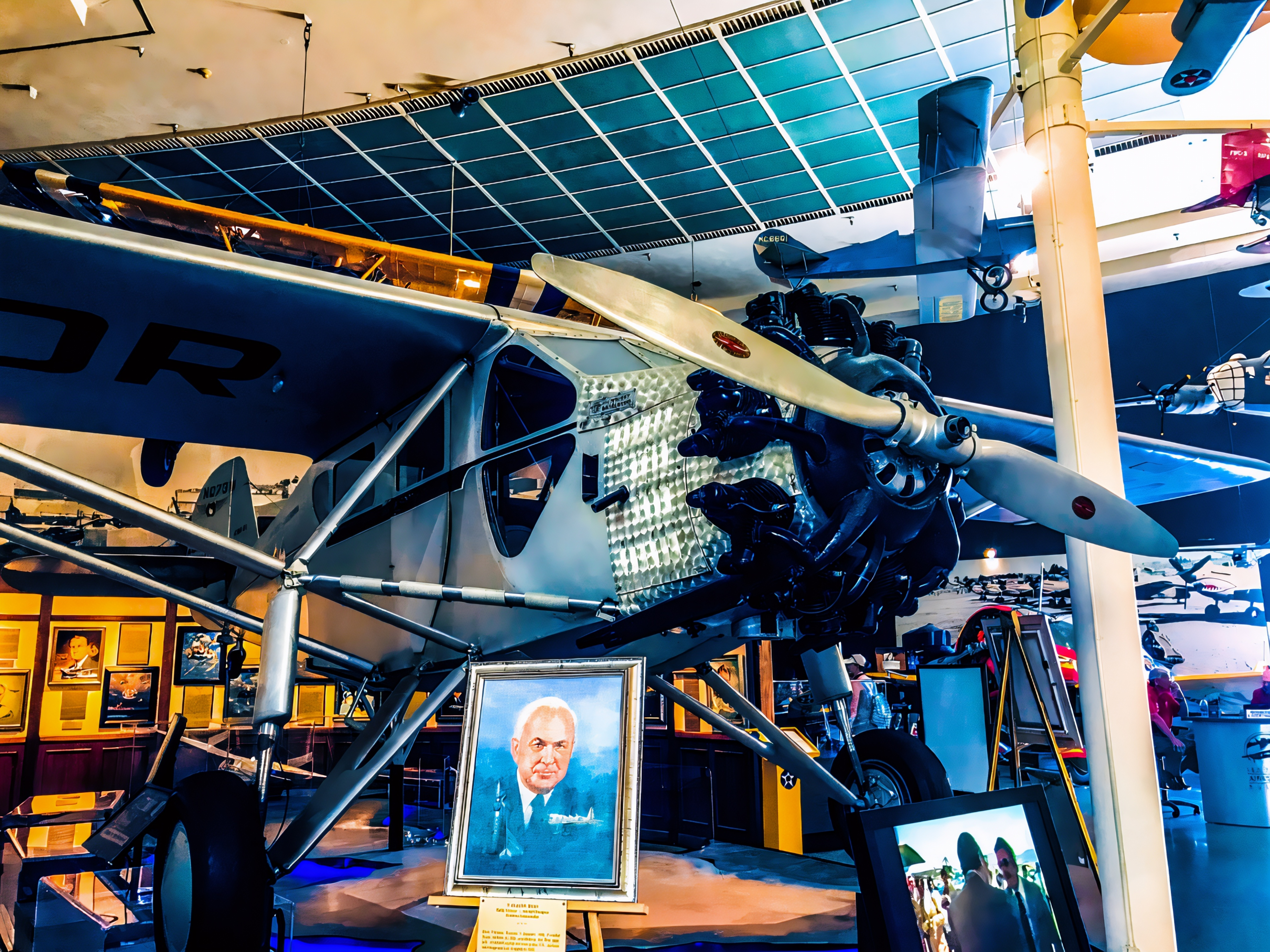

The San Diego Air & Space Museum, located in Balboa Park, invites visitors to explore how people progressed from early flying machines to jets and spacecraft. Housed in the historic Ford Building, this Smithsonian-affiliated museum combines aviation history with opportunities to appreciate science and engineering. Its galleries trace different eras of flight, revealing how aircraft designs changed as inventors and engineers pursued greater speed, range, and reliability. For travelers and science-lovers, the museum also provides a connection to San Diego’s aerospace heritage: local manufacturer Ryan Airlines built Charles Lindbergh’s famous Spirit of St. Louis (San Diego Air & Space Museum, n.d.-c, n.d.-d).
Visitors will find the museum at 2001 Pan American Plaza, making it a convenient stop during a broader exploration of Balboa Park. Tickets can be purchased online, and travelers should check the museum’s visitor page for current admission options, operating hours, and holiday closures before arriving. The museum provides accessibility information for guests with disabilities, while docent-led tours offer additional interpretation when guides are available. Travelers planning to visit several participating museums can also explore the Balboa Park Explorer Pass. Personal, noncommercial photography and video recording are permitted, allowing visitors to document favorite exhibits while following the museum’s photography policy (San Diego Air & Space Museum, n.d.-b).

Among the standout attractions is the Apollo 9 Command Module, which greets visitors in the entrance rotunda. Other galleries explore early military aviation, the barnstorming era, and the development of modern jets and spaceflight. Aircraft highlights include the Spitfire and Japanese Zero, while the Pavilion of Flight displays larger machines such as a Ford Trimotor, MiG-17, and F-4 Phantom. Space enthusiasts can also see Wally Schirra’s spacesuit and spacecraft reproductions. An interesting fact is that Schirra flew in all three of America’s early crewed space programs—Mercury, Gemini, and Apollo. Together, these exhibits offer a tangible way to consider the engineering challenges of carrying people through the atmosphere and into space (San Diego Air & Space Museum, n.d.-a).
The museum’s own history is a story of recovery and community support. It began with a relatively small collection and expanded as public interest grew, but a devastating fire destroyed its former home in Balboa Park’s Electric Building, consuming more than fifty aircraft and extensive historical collections. Staff, volunteers, donors, and local residents helped rebuild the institution in the Ford Building, where aircraft restoration became an important part of its work. Beyond the public galleries, the museum preserves an extensive library and archival collection containing aircraft manuals, historical records, photographs, and films. These resources make it both a visitor attraction and a place where the evidence of aviation’s development is protected for future study (San Diego Air & Space Museum, n.d.-c).
Visit the museum: https://sandiegoairandspace.org


References
San Diego Air & Space Museum. (n.d.-a). Exhibit galleries. https://sandiegoairandspace.org/exhibits/exhibit-galleries
San Diego Air & Space Museum. (n.d.-b). Hours & pricing. https://sandiegoairandspace.org/visit
San Diego Air & Space Museum. (n.d.-c). Museum history. https://sandiegoairandspace.org/museum/museum-history
San Diego Air & Space Museum. (n.d.-d). Museum overview. https://sandiegoairandspace.org/museum
AI Disclosure Statement:
Artificial intelligence tools were used in the creation of this page, including elements such as writing, image enhancement/generation, voice enhancement, and/or editing support. All final creative decisions were made by the creator.



Leave a Reply