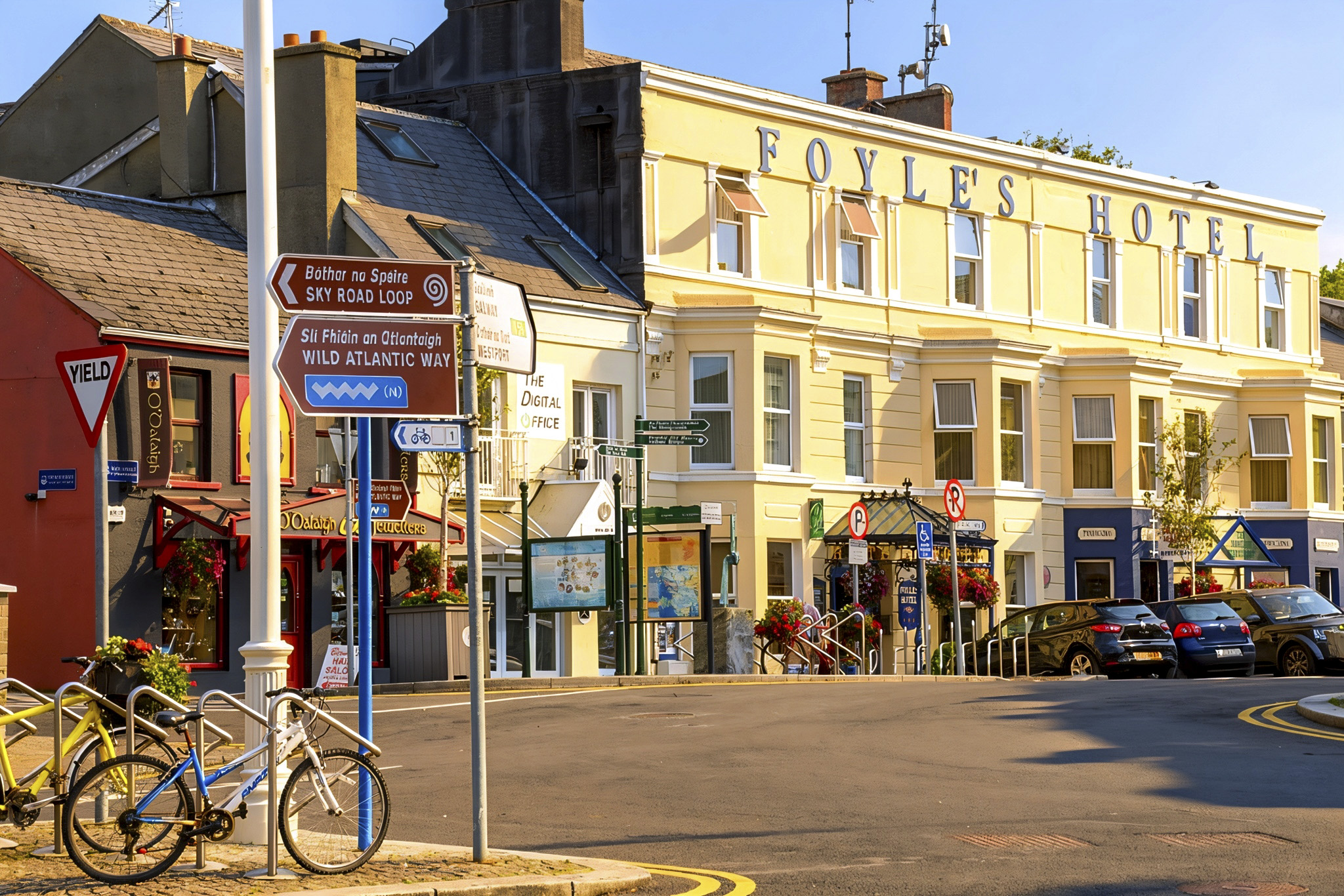

The photo captures the lively center of Clifden, County Galway, where Main Street meets the Market Square and colorful storefronts, bicycles, and the prominent Foyles Hotel reflect the town’s role as the commercial and tourism hub of Connemara. The bilingual road signs emphasize Clifden’s importance as a gateway to western Ireland: visitors can follow the Wild Atlantic Way toward Galway or Westport or explore the Sky Road, a scenic 16-kilometer loop suitable for driving and cycling. The route climbs above the Atlantic coastline and offers panoramic views of Clifden Bay and its offshore islands; travelers should allow time for viewpoints and take care on the narrow coastal road (Fáilte Ireland, n.d.).
Although Clifden has the appearance of a traditional Irish market town, it is comparatively young: local landowner John D’Arcy founded it in 1812 as a planned commercial center. The settlement expanded rapidly during the 1820s, growing from 46 houses and 290 residents in 1821 to 196 houses and 1,257 residents by 1831. Clifden later endured severe hardship during the Great Famine, but the arrival of the Galway–Clifden railway in 1895 helped revive its economy and encouraged tourism; the nearby Marconi wireless station and the 1919 landing of aviators John Alcock and Arthur Brown after the first nonstop transatlantic flight further secured the area’s place in communications and aviation history (Galway County Heritage Office, 2021).
References:
Fáilte Ireland. (n.d.). Sky Road. Discover Ireland.
Fáilte Ireland. (n.d.). Clifden Tourist Information Centre. Discover Ireland.
Galway County Heritage Office. (2021, July 19). History of Clifden. Galway Community Heritage.
AI Disclosure Statement:
Artificial intelligence tools were used in the creation of this page, including elements such as writing, image enhancement, voice enhancement, and/or editing support. All final creative decisions were made by the creator.




Leave a Reply