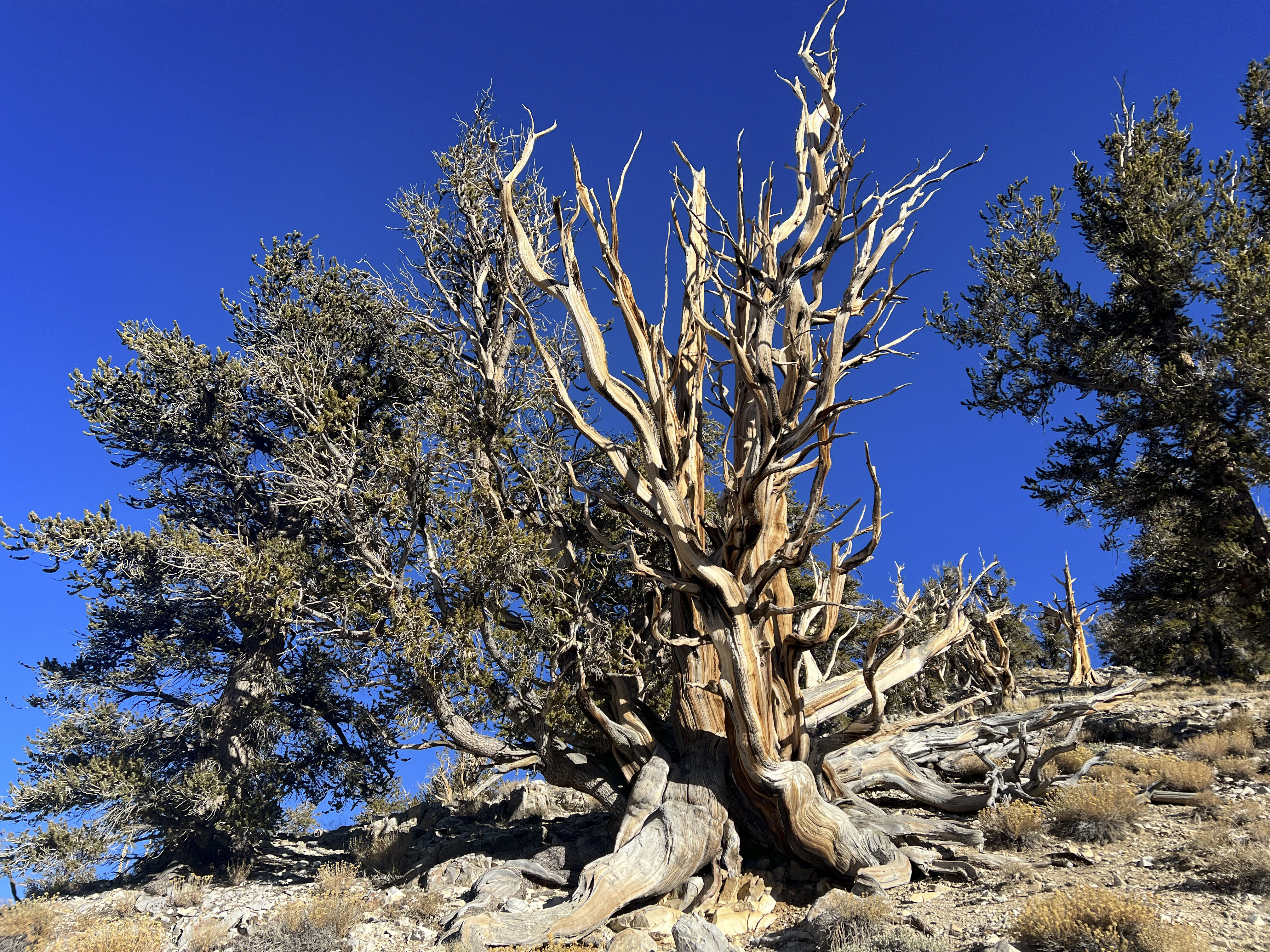

The Ancient Bristlecone Pine Forest protects roughly 31,700 acres in California’s White Mountains, east of the Owens Valley. Its Great Basin bristlecone pines (Pinus longaeva) include some of Earth’s oldest known non-clonal trees; many are more than 4,000 years old, and the famous Methuselah tree is over 4,800 years old. Its precise location is not marked to protect it, although visitors pass through its grove along the Methuselah Trail. Scientist Edmund Schulman began studying these trees during the 1950s, helping reveal their extraordinary ages, and the U.S. Forest Service established the original protected botanical area in 1958 (U.S. Forest Service, 2026a; U.S. Forest Service, Pacific Southwest Research Station, 2024).
The forest grows approximately 9,500 to 11,500 feet above sea level on cold, dry, windswept mountainsides. Many trees stand on pale dolomite, a magnesium-rich carbonate rock formed from ancient marine sediment. Its rocky, alkaline soil holds little water and makes survival difficult for most plants, reducing competition around the bristlecones. These harsh conditions slow the trees’ growth and produce dense, resinous wood that resists insects, fungi, and decay. A bristlecone can also survive after most of its trunk has died by keeping only a narrow strip of living bark connected to its roots and branches. Its needles may remain attached for decades, while wind, blowing ice, and erosion gradually sculpt the exposed wood into dramatic shapes (National Park Service, 2026; U.S. Forest Service, 2004).

The open woodland also contains limber pines, mountain mahogany, sagebrush, small alpine plants, lichens, and hardy wildflowers. Wildlife is less abundant than in lower forests, but visitors may encounter Clark’s nutcrackers, ravens, mountain chickadees, ground squirrels, mule deer, and other animals adapted to high elevations. Clark’s nutcrackers are especially important because they collect and bury pine seeds, sometimes leaving forgotten seeds that later grow. The newest major research news came in 2026, when scientists published the first reference genome for the Great Basin bristlecone pine. They assembled a genome containing about 23.8 billion DNA base pairs—roughly eight times the size of the human genome—to help investigate the tree’s longevity and ability to survive extreme environments. The researchers found no simple genetic explanation for its long life, but the new genome provides an important tool for future conservation and climate research (Neale et al., 2026). Earlier research also found that increasing heat, drought stress, and bark beetles have contributed to unexpected deaths in some populations (Bentz et al., 2022).
Most visitors begin at Schulman Grove, reached from Big Pine by following California Highway 168 and White Mountain Road. At about 10,000 feet, the grove has a seasonal visitor center and three self-guided routes: the one-mile Discovery Trail, the 4.5-mile Methuselah Trail, and the 3.5-mile Bristlecone Cabin Trail. Patriarch Grove, home to the largest known bristlecone pine, lies about 13 miles farther north at more than 11,000 feet. That final road is unpaved, rough, and unsuitable for many low-clearance vehicles. The area is generally accessible from mid-May through September, depending on snow and road conditions. Visitors should carry plenty of water, food, sun protection, warm clothing, and a full fuel tank because there is no potable water and cell service is limited. Camping, fires, and collecting wood are prohibited inside the forest, and hikers must remain on marked trails to protect the trees and fragile soil (U.S. Forest Service, 2026a, 2026b, 2026c).


References:
Bentz, B. J., Millar, C. I., Vandygriff, J. C., & Hansen, E. M. (2022). Great Basin bristlecone pine mortality: Causal factors and management implications. Forest Ecology and Management, 509, 120099.
National Park Service. (2026). Bristlecone pines.
Neale, D. B., Zimin, A. V., Millar, C. I., McGuire, P. E., Hosea, J. A., Li, E., Puiu, D., Timp, W., & Salzberg, S. L. (2026). A reference genome sequence for the exceptionally long-lived Great Basin bristlecone pine, Pinus longaeva. G3: Genes|Genomes|Genetics, 16(6), jkag064.
U.S. Forest Service. (2004). Pinus longaeva, Great Basin bristlecone pine.
U.S. Forest Service. (2026a). Ancient Bristlecone Pine Forest.
U.S. Forest Service. (2026b). Schulman Grove.
U.S. Forest Service. (2026c). Patriarch Grove Trailhead.
U.S. Forest Service, Pacific Southwest Research Station. (2024). White Mountain Research Natural Area.
AI Disclosure Statement:
Artificial intelligence tools were used in the creation of this page, including elements such as writing, image enhancement, voice enhancement, and/or editing support. All final creative decisions were made by the creator.


Leave a Reply