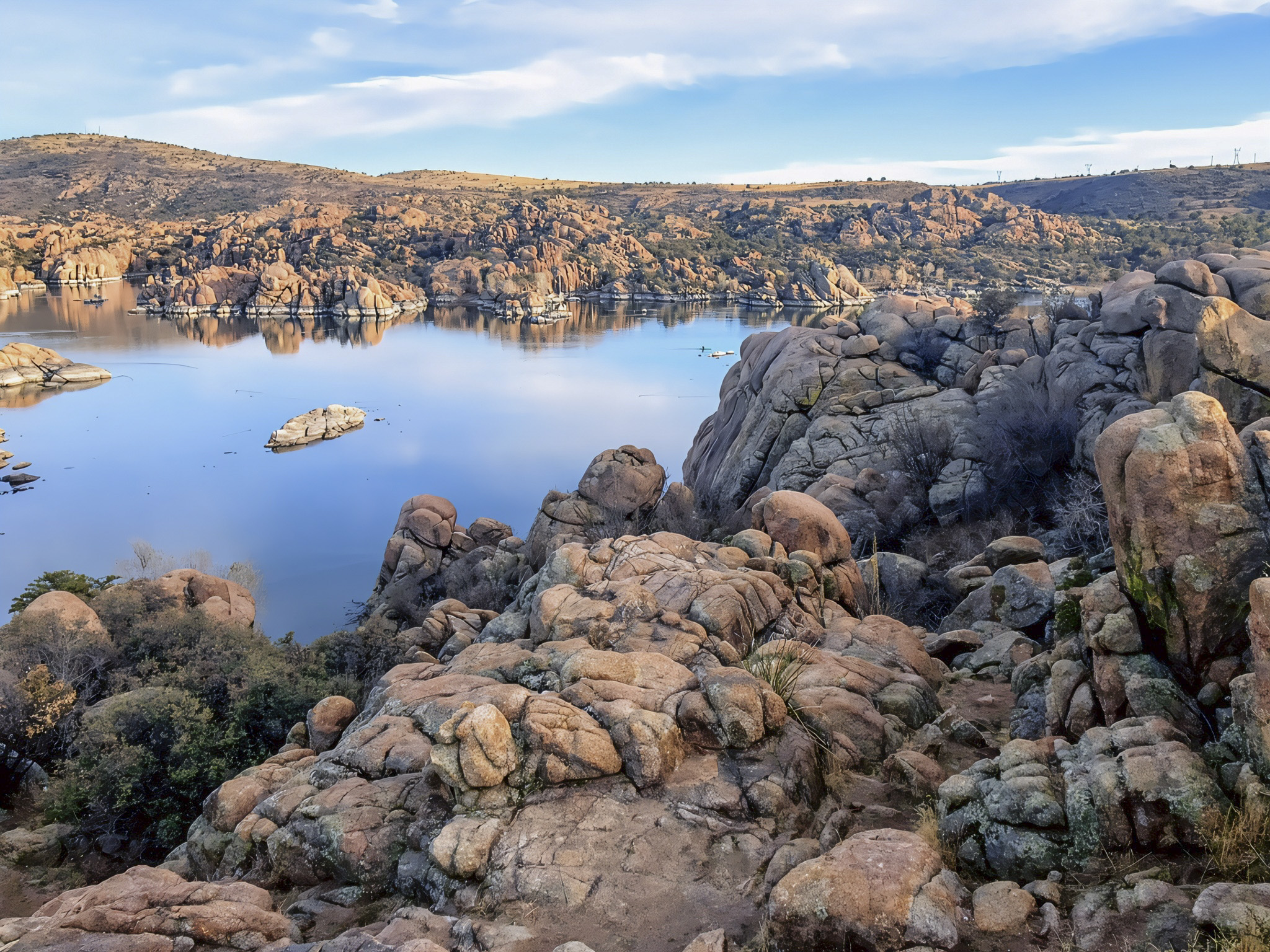

Watson Lake, about four miles from downtown Prescott, Arizona, brings together open water, rounded granite formations, and wildlife habitat in a setting that rewards both outdoor exploration and scientific curiosity. The surrounding Granite Dells form a maze of rocky coves and islands that visitors can explore by kayak or canoe. Reach the park from State Route 89 at 3101 Watson Lake Park Road; facilities include boat launches, picnic areas, restrooms, and seasonal camping. The city currently lists a parking fee, and swimming is prohibited. For walkers, the relatively level Peavine Trail offers an easier outing, while the nearly five-mile Watson Lake Loop involves more demanding travel over rocky terrain. Expect expansive views and uneven footing, so bring drinking water, sun protection, and sturdy shoes (Arizona Office of Tourism, n.d.; City of Prescott, n.d.-a).
The lake’s most striking geological feature is the Granite Dells, whose rocks formed approximately 1.4 billion years ago. This granite began as molten material beneath Earth’s surface, where it slowly cooled and crystallized before eventually becoming exposed. Its rounded shapes developed through spheroidal weathering: chemical breakdown attacks minerals along fractures, gradually softening angular blocks into curved forms. The Arizona Geological Survey identifies feldspar and mica among the minerals affected by this process. For science-minded travelers, the Dells offer an outdoor lesson in how ancient rock can acquire a remarkably sculpted appearance through prolonged weathering. The boulders surrounding the water therefore tell a much older story than the lake itself (Arizona Geological Survey, n.d.).

Watson Lake’s biological interest extends beyond its shoreline into nearby Watson Woods Riparian Preserve. This 126-acre protected area preserves part of a formerly much larger cottonwood-and-willow forest along Granite Creek. Its trees, pond, and streamside vegetation provide habitat for birds, mammals, reptiles, amphibians, and fish. Quiet visitors may encounter herons hunting near water, small mammals moving through grasses, or kingsnakes among fallen branches. The lake also supports fish such as largemouth bass, crappie, and catfish. Together, the open water and streamside woodland illustrate the importance of wet habitats within Arizona’s comparatively dry landscape. Watson Woods is also a restoration story: its habitat is recovering from past grazing, dumping, and gravel extraction through natural regeneration and conservation work (City of Prescott, n.d.-a; Prescott Creeks, n.d.).
Recent scientific news directly related to Watson Lake centers on water-quality monitoring and restoration, rather than a newly identified peer-reviewed discovery. In a 2026 project update, Prescott reported monthly water testing, four installed water circulators, and phosphorus-binding treatments intended to reduce the nutrients that support excessive algae and aquatic vegetation. The city reported no harmful algal or aquatic weed blooms during summer 2025 following its interventions, while its 2026 dashboard documents continued treatment. These are encouraging management observations, although they do not establish that every water-quality problem has been resolved. The dashboard also identifies a PFOS fish-consumption advisory for largemouth bass, making current advisories particularly relevant to anglers. For visitors, this ongoing work reveals a living scientific challenge: maintaining a recreational lake while managing nutrients, contaminants, and aquatic habitat (City of Prescott, 2026, n.d.-b).


References
- Arizona Geological Survey. (n.d.). Granite Dells, Prescott, Arizona. https://azgs.arizona.edu/granite-dells-prescott-arizona
- Arizona Office of Tourism. (n.d.). Watson Lake and the Granite Dells. https://www.visitarizona.com/places/parks-monuments/watson-lake-and-the-granite-dells
- City of Prescott. (n.d.-a). Watson Lake. https://prescott-az.gov/rec-services/recreation-areas-prescott/lakes/watson-lake
- City of Prescott. (n.d.-b). Prescott water quality dashboard. https://participateprescott.com/prescott-water-quality-dashboard
- City of Prescott. (2026). Watson Lake water enhancement [Project update]. https://prescott-az.gov/wp-content/uploads/2026/05/CIP-Watson-Lake-Water-Enhancement-5.26-20260505.pdf
- Prescott Creeks. (n.d.). Watson Woods Riparian Preserve. https://prescottcreeks.org/programs/watson-woods
AI Disclosure Statement:
Artificial intelligence tools were used in the creation of this page, including elements such as writing, image enhancement/generation, voice enhancement, and/or editing support. All final creative decisions were made by the creator.


Leave a Reply