

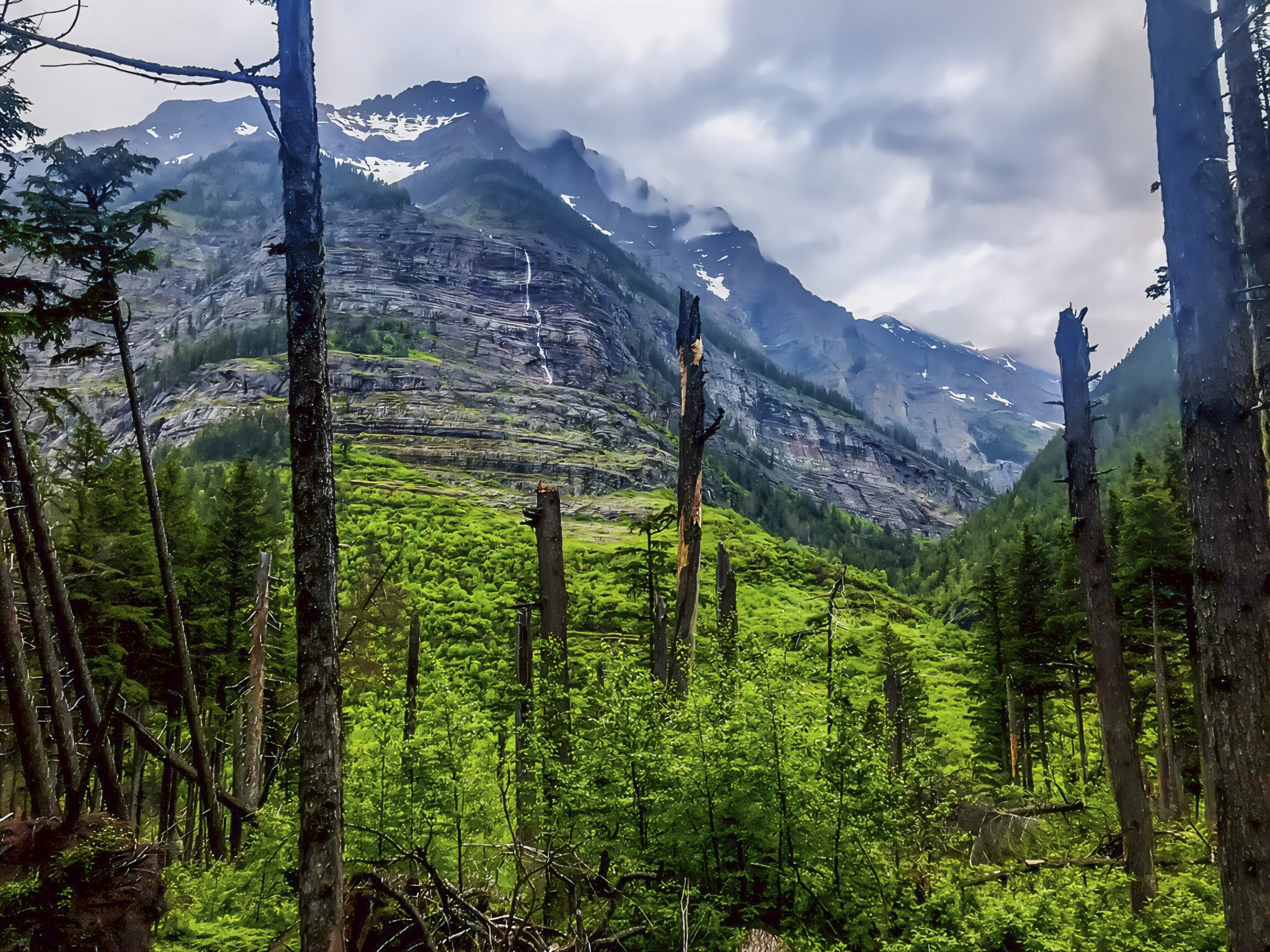
Located in Glacier National Park, Montana, Avalanche Lake is one of the park’s most remarkable hiking destinations, offering visitors an opportunity to explore a landscape shaped by ancient glaciers. Surrounded by towering mountains, dense forests, and waterfalls, this alpine lake lies within a valley carved by massive ice formations during the last Ice Age. The surrounding landscape provides an excellent example of how glaciers transformed the Rocky Mountains over thousands of years. According to the National Park Service (n.d.-a), glaciers moved through mountain valleys, gradually eroding the underlying rock and creating the broad, U-shaped valleys that characterize much of Glacier National Park. Today, Avalanche Lake offers travelers, hikers, and nature enthusiasts an opportunity to experience this geological history while enjoying one of the park’s most scenic natural environments.
Reaching Avalanche Lake requires a moderately challenging hike of approximately 4.6 miles (7.4 kilometers) round trip, beginning near the Avalanche Picnic Area along Going-to-the-Sun Road. The route starts along the Trail of the Cedars, an accessible nature trail that passes through an old-growth forest before connecting with the Avalanche Lake Trail. The hike involves uphill sections, rocky terrain, and an overall elevation increase of roughly 500 feet (152 meters), although the National Park Service reports approximately 741 feet (226 meters) of cumulative climbing along the one-way trail. Along the route, hikers encounter Avalanche Creek, where flowing water has carved a narrow gorge through the surrounding rock. The trail eventually reaches the lakeshore, where visitors can rest, explore designated areas, and appreciate the surrounding alpine environment. Because of uneven terrain and changing mountain conditions, hikers should wear appropriate footwear, carry drinking water, and remain alert to wildlife (National Park Service, n.d.-b, n.d.-c).

The geological history of Avalanche Lake is closely connected to the movement of glaciers that once covered much of the region. During the Pleistocene Ice Age, enormous masses of ice moved slowly through mountain valleys, scraping and removing rock through processes known as glacial erosion. As these glaciers advanced, they widened valleys, steepened mountain walls, and helped create the lake basins found throughout the park. Avalanche Lake occupies one of these glacially carved valleys, surrounded by rugged peaks shaped by millions of years of geological activity. The waterfalls descending from the surrounding mountains are largely supplied by melting snow and seasonal precipitation, demonstrating how water continues to influence the landscape long after the retreat of the major Ice Age glaciers. Flowing water also transports sediment and gradually reshapes stream channels, showing that geological processes remain active throughout Glacier National Park (National Park Service, n.d.-a, n.d.-d).
Beyond its geological significance, Avalanche Lake is part of a diverse mountain ecosystem where forests, freshwater environments, and alpine habitats interact. The surrounding old-growth forests provide habitat for wildlife, while Avalanche Creek connects the lake’s watershed with ecosystems farther downstream. Trees and other vegetation help stabilize soils, influence water movement, and provide shelter for organisms living along forest streams. Seasonal snowmelt and precipitation supply freshwater to mountain streams and lakes, supporting aquatic habitats and transporting nutrients and sediments through the watershed. The surrounding mountains also create different environmental conditions as elevation increases, contributing to changes in vegetation and wildlife habitats. For travelers and science-lovers, a visit to Avalanche Lake offers more than a rewarding hiking experience. It provides an opportunity to understand the connections between geology, water, forests, and wildlife, while appreciating the natural processes that continue to shape Glacier National Park (National Park Service, n.d.-d, n.d.-e).


References
National Park Service. (n.d.-a). Glacial geology. Glacier National Park. U.S. Department of the Interior. https://www.nps.gov/glac/learn/nature/glacial-geology.htm
National Park Service. (n.d.-b). Avalanche Lake Trail. Glacier National Park. U.S. Department of the Interior. https://www.nps.gov/places/avalanche-lake-trail.htm
National Park Service. (n.d.-c). Hike to Avalanche Lake. Glacier National Park. U.S. Department of the Interior. https://www.nps.gov/thingstodo/hike-to-avalanche-lake.htm
National Park Service. (n.d.-d). Geologic activity. Glacier National Park. U.S. Department of the Interior. https://www.nps.gov/glac/learn/nature/geologicactivity.htm
National Park Service. (n.d.-e). Park information. Glacier National Park. U.S. Department of the Interior. https://www.nps.gov/glac/learn/education/park-information.htm
AI Disclosure Statement:
Artificial intelligence tools were used in the creation of this page, including elements such as writing, image enhancement/generation, voice enhancement, and/or editing support. All final creative decisions were made by the creator.


Leave a Reply