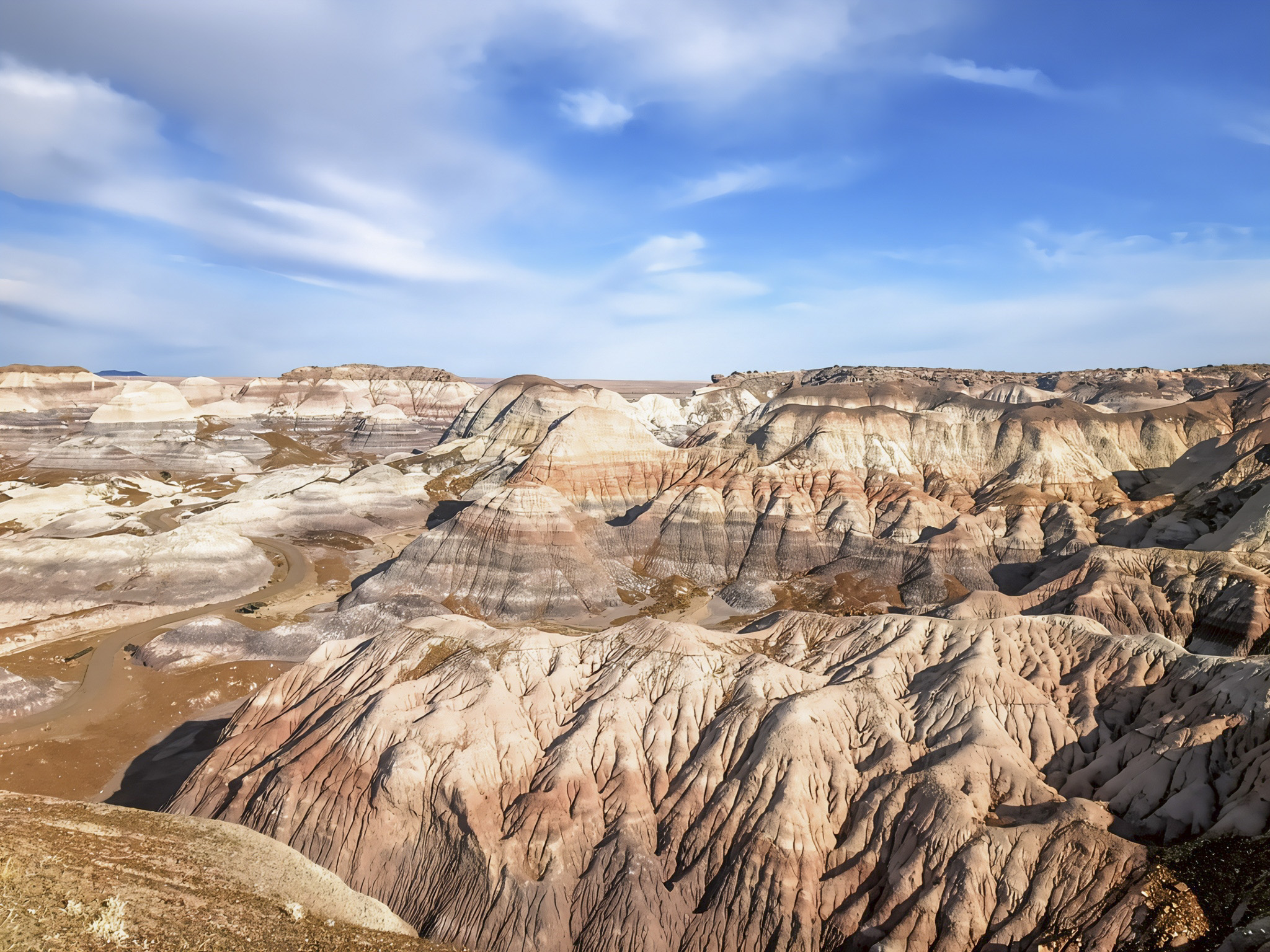

Blue Mesa is one of the most striking landscapes in Arizona’s Petrified Forest National Park, where blue, purple, gray, and peach bands sweep across rounded badland hills. Part of the Painted Desert, this area offers scenic overlooks, exposed petrified wood, and a chance to walk among rock layers preserving an ancient world. A scenic spur road near the middle of the park provides an approximately five-mile round-trip drive. For a closer look, the one-mile Blue Mesa Trail descends from the mesa into the badlands. Its paved and gravel surfaces include a steep section, so visitors should prepare for an uphill return, bring water and sun protection, and check park operating hours before visiting (National Park Service [NPS], 2021a, 2021b).
Blue Mesa’s scenery began forming more than 200 million years ago, when rivers deposited sediment during the Late Triassic Period. The mesa exposes the Blue Mesa and Sonsela members of the Chinle Formation, with resistant sandstone helping protect softer layers beneath it. Erosion has gradually carved these deposits into the hills and gullies visible today. The trail passes bentonite-rich clay, while the colorful bands record differences in ancient soil conditions and mineral chemistry. Bluish and greenish shades developed where waterlogged, oxygen-poor conditions affected iron minerals; reddish colors reflect iron oxidation, a process similar to rusting. These layers therefore reveal clues about ancient groundwater and environments, not simply an attractive pattern (NPS, 2020, 2021a, 2021b).

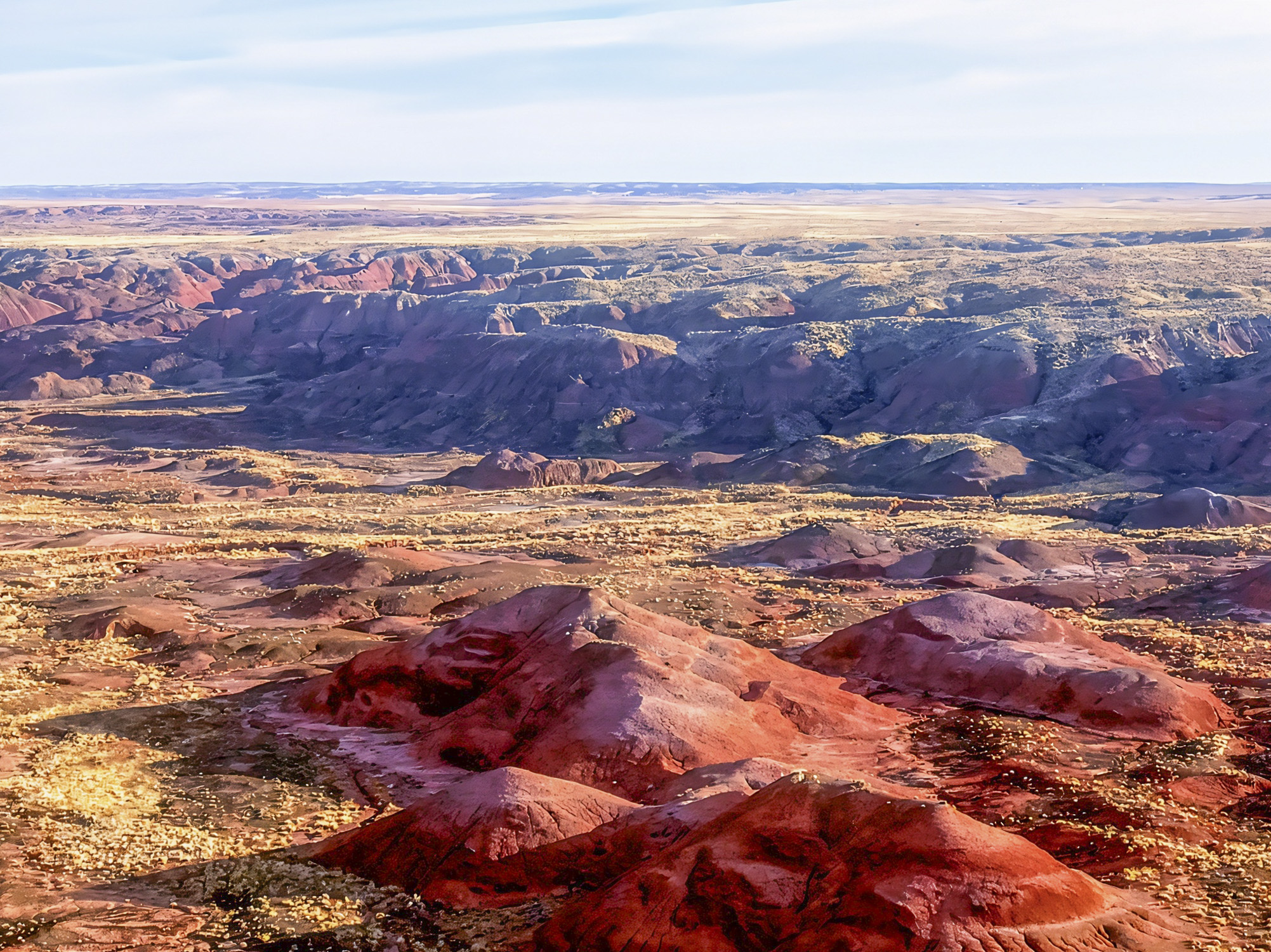
Although the bare slopes may appear lifeless, Blue Mesa sits within a park that supports grasslands, drought-adapted plants, and diverse wildlife. Across the surrounding landscape, grasses and wildflowers respond to favorable moisture, while plants such as cacti and yuccas have adaptations that help them withstand dry conditions. Birds, lizards, and rabbits are among the park’s most frequently observed animals, although sightings depend on weather and season. Many animals avoid intense summer heat by becoming active around dawn, dusk, or at night. For travelers, looking carefully at vegetation and watching quietly for movement can reveal the living ecosystem alongside the fossil landscape; wildlife should always be observed without feeding or disturbing it (NPS, 2025a, 2025b).
Recent research adds new meaning to the ancient trees preserved in this landscape. A 2026 study in Lithodendron, the park’s peer-reviewed journal, found that two relatively rare fossil wood types, Schilderia and Woodworthia, occur in older rock layers than previously recognized. Their expanded fossil record suggests that these trees persisted for at least seven million years and occupied a wider range of environments than scientists had understood. The study also connects their fossil distribution with changes in climate, river systems, volcanic activity, and preservation conditions. Although this research concerns the broader park rather than the Blue Mesa Trail specifically, it helps visitors understand why each petrified log and sedimentary layer can contribute to an evolving picture of Triassic ecosystems (Parker, 2026).


References
- National Park Service. (2020). Geologic formations. https://www.nps.gov/pefo/learn/nature/geologicformations.htm
- National Park Service. (2021a). Blue Mesa. https://www.nps.gov/places/blue-mesa.htm
- National Park Service. (2021b). Walk Blue Mesa Trail. https://www.nps.gov/thingstodo/walk-blue-mesa-trail.htm
- National Park Service. (2025a). Animals. https://www.nps.gov/pefo/learn/nature/animals.htm
- National Park Service. (2025b). Plants. https://www.nps.gov/pefo/learn/nature/plants.htm
- Parker, W. G. (2026). Climate, tectonics, fluvial reorganization, and the resultant biostratigraphic expansion of the fossil woods Schilderia and Woodworthia from the Chinle Formation (Upper Triassic) of Petrified Forest National Park, Arizona. Lithodendron, 3.
AI Disclosure Statement:
Artificial intelligence tools were used in the creation of this page, including elements such as writing, image enhancement/generation, voice enhancement, and/or editing support. All final creative decisions were made by the creator.


Leave a Reply