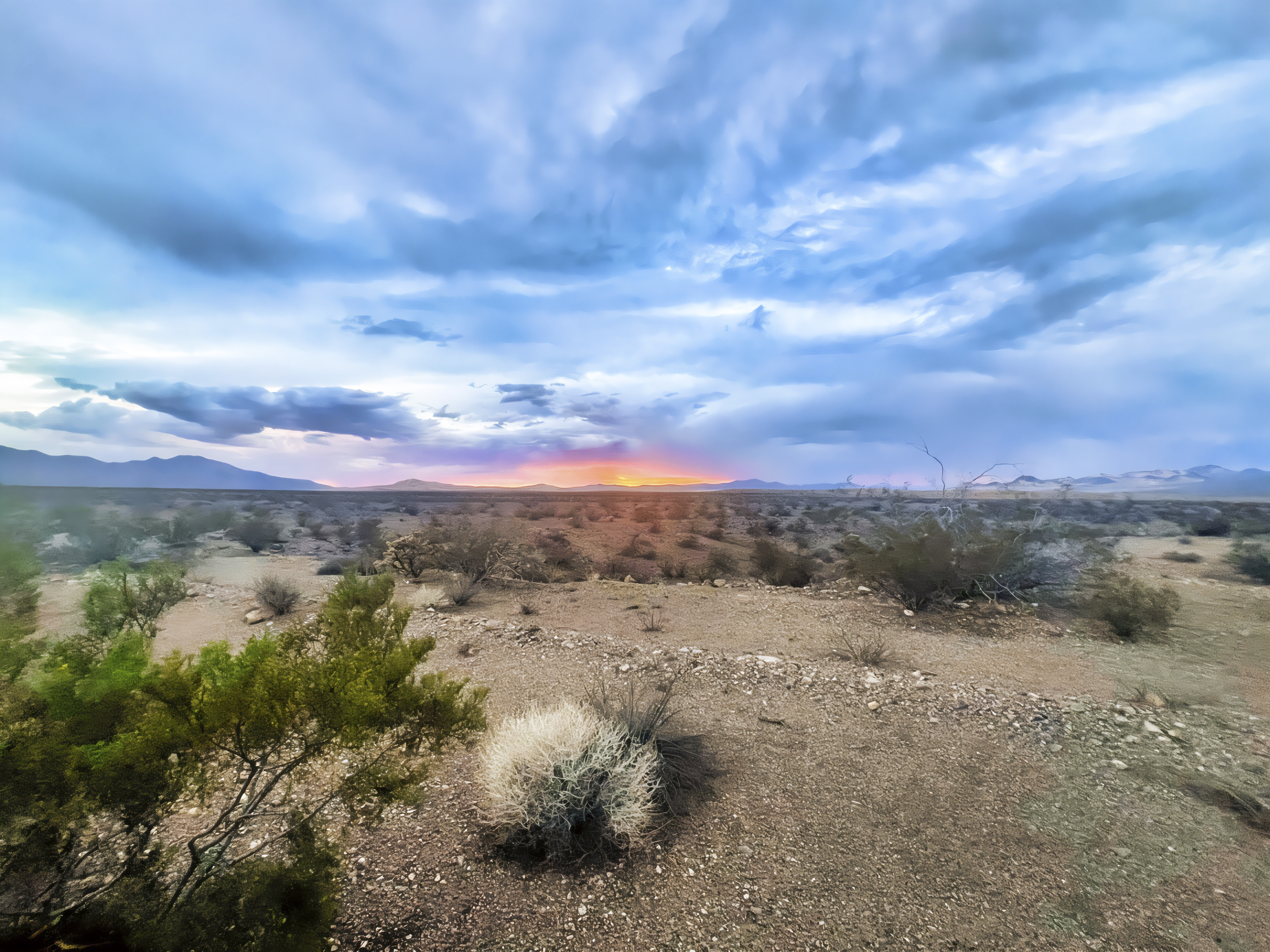

Mojave National Preserve encompasses approximately 1.6 million acres of southeastern California, protecting a vast landscape of rugged mountain ranges, volcanic formations, sand dunes, dry lakebeds, Joshua tree woodlands, and creosote-covered valleys. Its open terrain and far-reaching views make the preserve especially rewarding near sunset, when the lowering sun softens the desert’s harsh textures and casts warm golden light across distant ridges and scattered vegetation (National Park Service [NPS], n.d.).
During sunset, travelers may see the horizon glow in shades of gold, orange, pink, and red while mountains and desert shrubs become dramatic silhouettes beneath the fading sky. These colors develop because low-angle sunlight travels through more of Earth’s atmosphere, where shorter blue and green wavelengths are scattered away, leaving warmer wavelengths more visible; clouds may intensify the display by reflecting the final red-orange light of the day (National Oceanic and Atmospheric Administration [NOAA], 2023). As twilight approaches, expect the temperature to fall quickly and the preserve’s quiet, spacious landscape to transition toward remarkably dark skies—visitors should bring an extra layer, carry water, and remember that cellular service is unreliable (NPS, n.d.).


References:
National Oceanic and Atmospheric Administration. (2023). The clouds outside my window. https://www.noaa.gov/sites/default/files/2023-03/CloudsOutMyWindow.pdf
National Park Service. (n.d.). Nature and science: Mojave National Preserve. https://www.nps.gov/moja/learn/nature/index.htm
National Park Service. (n.d.). Trip ideas: Mojave National Preserve. https://www.nps.gov/moja/planyourvisit/trip-ideas.htm
AI Disclosure Statement:
Artificial intelligence tools were used in the creation of this page, including elements such as writing, image enhancement, voice enhancement, and/or editing support. All final creative decisions were made by the creator.


Leave a Reply