

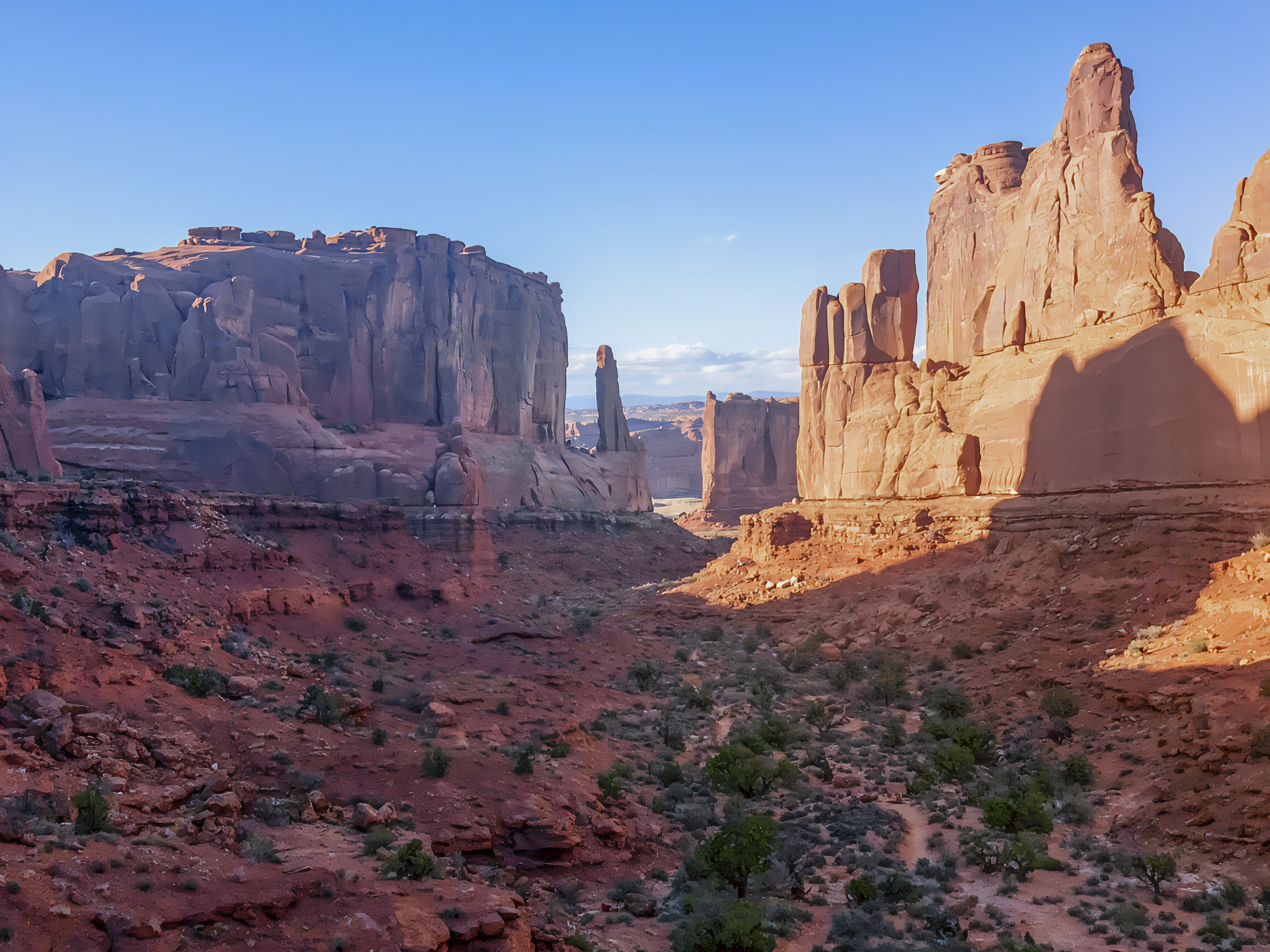
Courthouse Towers is one of the first major scenic areas visitors encounter after climbing the entrance switchbacks into Arches National Park near Moab, Utah. This collection of sandstone walls and isolated towers includes the Organ, the Tower of Babel, and the Three Gossips, making the stretch where you took your photographs an excellent introduction to the park’s monumental landscape. Roadside viewpoints provide convenient opportunities to appreciate the formations, while the Park Avenue Trail offers a closer experience beneath their towering walls. The trail connects Park Avenue Viewpoint with Courthouse Towers over approximately one mile each way. Starting at the Courthouse Towers end allows visitors to explore the canyon floor and turn back before the steep stairs at the opposite end; hikers should return along the trail rather than walk beside the road (National Park Service [NPS], 2022, 2025e).
The formations’ names invite visitors to imagine familiar shapes in the sandstone: Courthouse Towers suggests monumental civic buildings, the Organ evokes the upright pipes of a musical instrument, the Tower of Babel alludes to the biblical tower, and the Three Gossips resembles three figures gathered in conversation. These are interpretations of their appearance and wording, rather than a documented account of who first named each formation. The National Park Service describes the names as imaginative and notes that the Three Gossips is also called the Three Kings. Nearby Park Avenue received its name because its sheer walls reminded early visitors of buildings lining a city street (NPS, 2022, 2025e). Human connections to this landscape extend far beyond those familiar names: the park lies within the ancestral and traditional homelands of several Indigenous peoples, including Hopi, Ute, Paiute, Navajo, and Zuni communities (NPS, 2025d).

Geologically, Courthouse Towers reveals how ancient sand deposits became a landscape of cliffs, fins, and freestanding rock monuments. Its prominent walls are formed from Entrada Sandstone, a rock unit associated with ancient desert dunes (U.S. Geological Survey, n.d.; NPS, 2025c). Deep beneath the park, buried salt shifted under the weight of overlying rock, bending the layers above and helping create fractures. Regional uplift and erosion subsequently exposed the sandstone, allowing water to enter those weaknesses. Rainwater gradually loosens the mineral cement between sand grains, while freezing water can widen cracks and break away pieces of rock. Over long periods, these processes separate rock masses and reshape their outlines. Although wind is an obvious presence in this desert, the National Park Service identifies water as the strongest force shaping the landscape today (NPS, 2025c).
The open ground around Courthouse Towers also supports a living desert ecosystem. Grasses and shrubs share the soil with biological crusts—communities of cyanobacteria, lichens, mosses, fungi, and other tiny organisms that help stabilize sand, retain moisture, and supply nutrients. Some crust organisms convert atmospheric nitrogen into forms plants can use, linking microscopic life beneath visitors’ feet to the vegetation around the towers (NPS, 2025b). Across Arches, birds, lizards, and small mammals are among the animals visitors most often notice, while many other species avoid intense heat by becoming active at night or during cooler parts of the day (NPS, 2025a). For travelers and science-lovers, this makes the area more than a collection of spectacular rocks: it is a place where geology and biology interact. Staying on established trails protects fragile soil communities that can take many years to recover after being trampled (NPS, 2025b).


References
National Park Service. (2022). Courthouse Towers viewpoint and trailhead. https://www.nps.gov/places/courthouse-towers-viewpoint.htm
National Park Service. (2025a). Animals. https://www.nps.gov/arch/learn/nature/animals.htm
National Park Service. (2025b). Biological soil crust activity. https://www.nps.gov/arch/learn/kidsyouth/biologicalsoilcrust.htm
National Park Service. (2025c). Geologic formations. https://www.nps.gov/arch/learn/nature/geologicformations.htm
National Park Service. (2025d). History & culture. https://www.nps.gov/arch/learn/historyculture/index.htm
National Park Service. (2025e). Park Avenue and Courthouse Towers. https://www.nps.gov/arch/planyourvisit/courthouse-towers.htm
U.S. Geological Survey. (n.d.). Walls of Entrada Sandstone, Courthouse Towers, Arches National Park. https://www.usgs.gov/media/images/walls-entrada-sandstone-courthouse-towers-arches-national-park
AI Disclosure Statement:
Artificial intelligence tools were used in the creation of this page, including elements such as writing, image enhancement/generation, voice enhancement, and/or editing support. All final creative decisions were made by the creator.
Leave a Reply