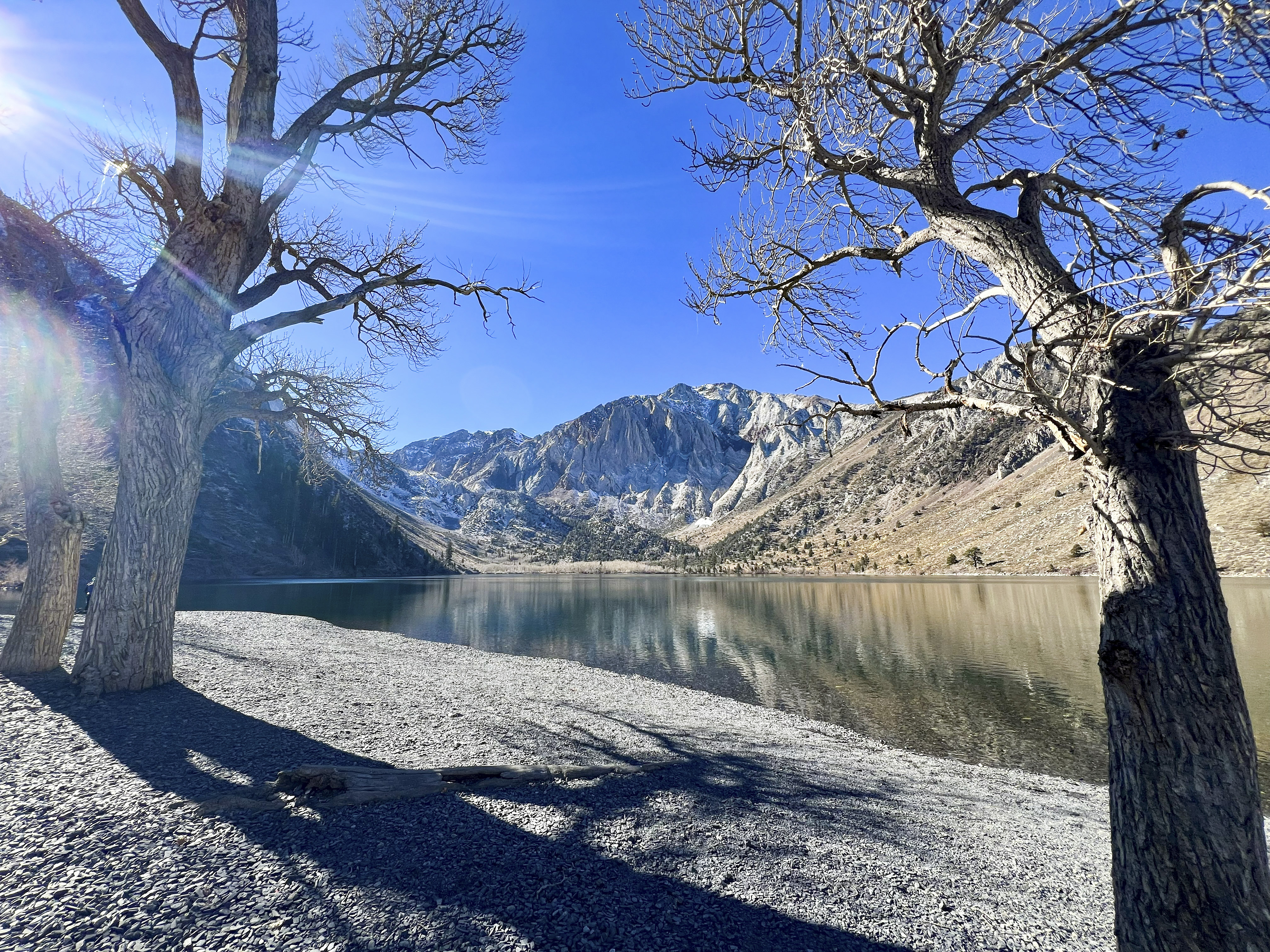

Convict Lake is a 167-acre alpine lake at about 7,500 feet in Mono County’s Sherwin Range, near Mammoth Lakes and roughly five paved miles south of town via U.S. 395. Visitors come for trout fishing, boating, swimming, fall color, and the scenic 3.5-mile loop trail; the adjacent campground has reservable and first-come sites, drinking water, toilets, and bear-resistant food lockers. Wildlife may include black bears, mule deer, mountain lions, pine martens, pikas, and numerous bird species, while aspen and cottonwood grow along Convict Creek. Travelers should store food securely, expect snow and cold conditions outside summer, and check current road, campground, fire, and fishing regulations before visiting (Recreation.gov, n.d.). The lake’s modern name commemorates an 1871 confrontation between a posse and escaped Nevada prisoners near what was then Monte Diablo Creek; posse members Robert Morrison and Mono Jim were killed, and nearby Mount Morrison and Mono Jim Peak were subsequently named for them (Mono County Sheriff’s Office, n.d.).
Geologically, Convict Lake occupies a glacier-shaped basin dammed by terminal moraine deposits, with steep, erosion-prone margins and sediment layers recording changing lake levels, slope failures, volcanic ash falls, and environmental change. The surrounding dark, dramatically folded rocks include hornfels, metachert, slate, marble, and sandstone—some belonging to the Late Ordovician Convict Lake Formation (U.S. Geological Survey, 2026). Its cold, clear aquatic habitat supports rainbow and brown trout, while shoreline shrubs, riparian trees, pollen, algae, invertebrates, fish, birds, and mammals form a compact high-elevation food web. The newest directly focused peer-reviewed research located, published in April 2025, combined seismic imaging, sediment cores, radiocarbon dating, pollen, and microcharcoal: it reconstructed approximately 9,300 years of lake history, identified a major lake-level transition about 4,300 years ago, and found increasingly variable climatic and tectonic signals after roughly 2,200 years ago—showing that this popular recreation lake is also a valuable archive of Sierra Nevada climate, vegetation, fire, and geological hazards (Hodelka et al., 2025).


References:
Hodelka, B. N., Black, M., Benfield, A. J., Ivory, S. J., Woolery, E. W., Woller, K., Zimmerman, S. R. H., & McGlue, M. M. (2025). Sedimentary records of late Pleistocene–Holocene paleoenvironments from Convict Lake (California, USA). Quaternary International, 724, Article 109739. https://doi.org/10.1016/j.quaint.2025.109739
Mono County Sheriff’s Office. (n.d.). Department history. https://www.monocounty.ca.gov/1231/Department-History
Recreation.gov. (n.d.). Convict Lake Campground, Inyo National Forest. https://www.recreation.gov/camping/campgrounds/234311
U.S. Geological Survey. (2026). Geolex—Convict Lake. https://ngmdb.usgs.gov/Geolex/Units/ConvictLake_5072.html
AI Disclosure Statement:
Artificial intelligence tools were used in the creation of this page, including elements such as writing, image enhancement, voice enhancement, and/or editing support. All final creative decisions were made by the creator.

Leave a Reply