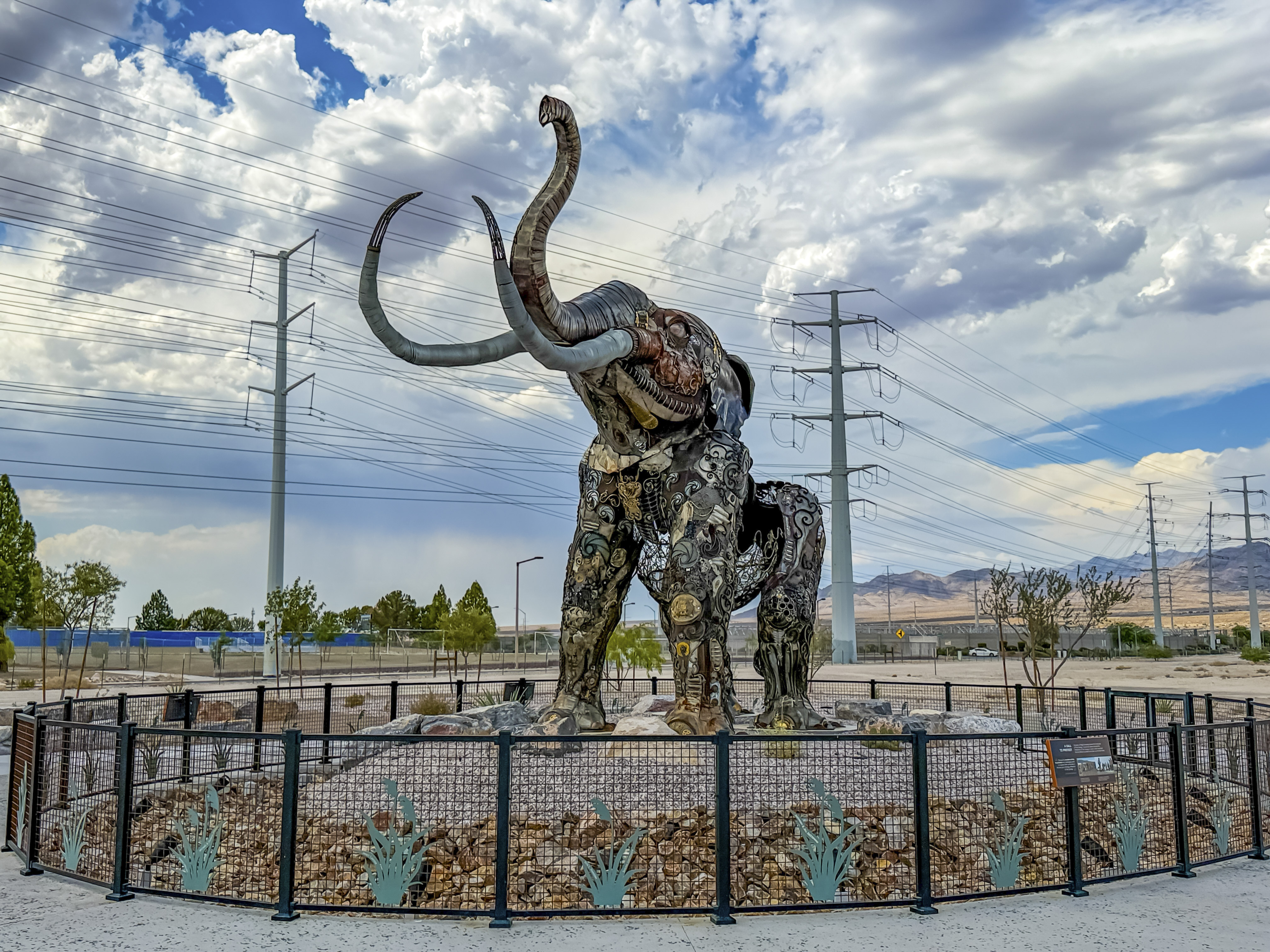

Ice Age Fossils State Park in North Las Vegas offers travelers a remarkable opportunity to explore the prehistoric landscape that existed in southern Nevada during the Pleistocene Epoch. The 315-acre park protects part of the Upper Las Vegas Wash, where scientists have discovered abundant fossils of Columbian mammoths, ancient bison, camels, horses, dire wolves, American lions, and giant ground sloths. The area became especially important to science during the 1962–1963 Tule Springs Expedition, commonly called the “Big Dig,” when researchers excavated extensive trenches while investigating the region’s geology, fossils, and possible evidence of early humans. Today, visitors can explore an interactive visitor center and nearly four miles of trails, including the 0.3-mile Megafauna Trail, 1.5-mile Las Vegas Wash Trail, and 1.2-mile Big Dig Trail (Nevada Division of State Parks, n.d.).
For travelers, the park provides an accessible introduction to Ice Age science only a relatively short drive from central Las Vegas. The visitor center contains natural-history exhibits and fossil displays, while the Megafauna Trail uses life-sized sculptures and interpretive information to recreate animals that once inhabited the valley. The Big Dig Trail leads visitors into landscapes shaped by the famous scientific expedition, while the Las Vegas Wash Trail provides a closer look at the natural processes that continue to reshape the desert. Travelers should check current conditions and hours before visiting, particularly because washes and trenches can be affected by weather (Nevada Division of State Parks, n.d.). The surrounding Mojave Desert is extremely hot during summer, making cooler months and cooler portions of the day more comfortable for hiking.
Geologically, the park is part of the larger Tule Springs landscape, where sediments of the Las Vegas Formation preserve an extraordinary record of changing water, climate, and ecosystems. Although today’s landscape is arid, groundwater-fed springs, streams, marshes, and wet meadows repeatedly occupied the Upper Las Vegas Valley during wetter intervals of the Pleistocene. The geologic record of the broader Tule Springs area extends back roughly 570,000 years, while fossils are especially abundant in sediments dating from about 100,000 to 12,500 years ago (National Park Service, 2025a). These ancient wetlands supported not only enormous mammals but also fish, turtles, birds, rodents, reptiles, snails, and vegetation such as cattails, cottonwoods, ash, juniper, and pine. As the climate warmed and wetlands contracted near the end of the Pleistocene, the ecosystem gradually became more like the Mojave Desert seen today, while many large mammals disappeared from the local fossil record (National Park Service, 2025a; Springer et al., 2018).
Immediately adjacent to the state park is Tule Springs Fossil Beds National Monument, a 22,650-acre National Park Service unit established in 2014 that protects thousands of Pleistocene fossils and much of the surrounding fossil-rich landscape (National Park Service, 2025b). Together, the state park and national monument function as an exceptional outdoor laboratory for understanding how desert ecosystems respond to major climatic and hydrologic changes. Research remains active: National Park Service information documents U.S. Geological Survey scientists collecting samples from a historic 1963 trench in 2024 as part of continuing investigations of the area’s geology, stratigraphy, geochronology, and past climate (National Park Service, 2025c). Another recent study published in 2025 used X-ray fluorescence analysis to trace the famous Tule Springs obsidian flake discovered in 1933 to an obsidian source about 185 kilometers away, renewing scientific interest in the archaeological history of Tule Springs and questions about ancient human activity in the region (Jenkins et al., 2025). For science-minded travelers, Ice Age Fossils State Park and neighboring Tule Springs therefore offer something unusual: a modern Mojave Desert landscape where fossils, sediments, and ongoing research reveal a much wetter world once populated by some of North America’s most spectacular Ice Age animals.


References:
Jenkins, D. L., et al. (2025). Reintroducing Tule Springs: Obsidian sourcing of the initial find and a case study on archaeological value at the intersection of science and public interest. Journal of California and Great Basin Anthropology, 45(1), 35–54.
National Park Service. (2025a). About fossils: Tule Springs Fossil Beds National Monument. U.S. Department of the Interior.
National Park Service — About Fossils
National Park Service. (2025b). Basic information: Tule Springs Fossil Beds National Monument. U.S. Department of the Interior.
National Park Service — Basic Information
National Park Service. (2025c). Climate & Earth science: Tule Springs Fossil Beds National Monument. U.S. Department of the Interior.
National Park Service — Climate & Earth Science
Nevada Division of State Parks. (n.d.). Ice Age Fossils State Park. Nevada Department of Conservation and Natural Resources.
Nevada State Parks — Ice Age Fossils State Park
Springer, K. B., Pigati, J. S., & Scott, E. (2018). The geology and paleontology of Tule Springs Fossil Beds National Monument, Nevada. U.S. Geological Survey Fact Sheet 2018–3038.
U.S. Geological Survey — Geology and Paleontology of Tule Springs
AI Disclosure Statement:
Artificial intelligence tools were used in the creation of this page, including elements such as writing, image enhancement, voice enhancement, and/or editing support. All final creative decisions were made by the creator.


Leave a Reply