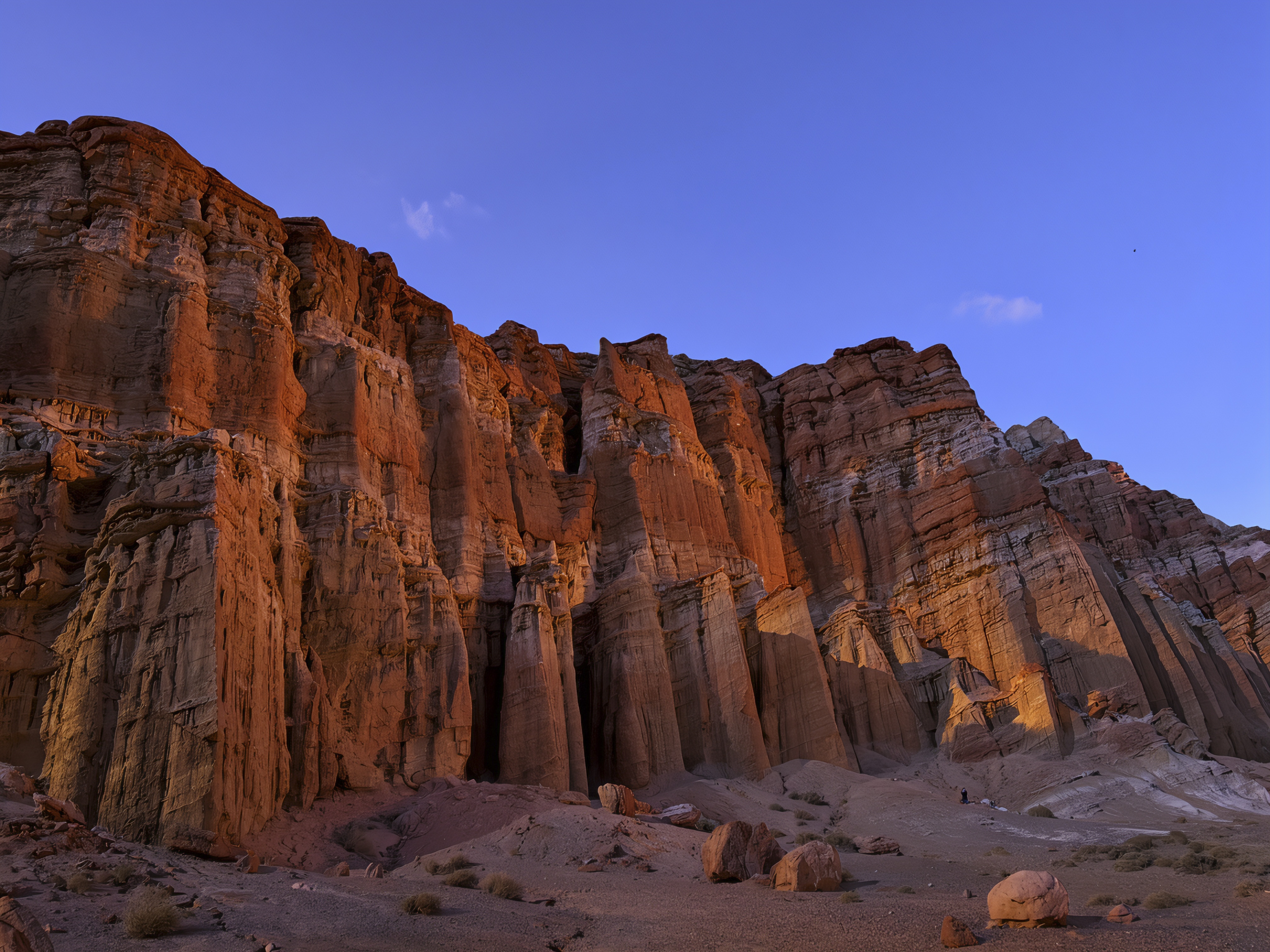

The Red Cliffs are among the most striking formations in California’s Red Rock Canyon State Park, where the southern Sierra Nevada meets the El Paso Mountains in the western Mojave Desert. Located about 25 miles northeast of Mojave along California Highway 14, the area features towering red-and-gray sandstone cliffs, desert washes, and a self-guided nature trail that introduces visitors to the landscape’s fossil history. The cliffs belong largely to the Ricardo Group, deposited between approximately 5 and 20 million years ago as rivers, lakes, volcanic eruptions, and floods laid down alternating beds of sediment and volcanic material; iron oxides give many layers their characteristic red coloring, while uplift along faults and continuing erosion exposed and sculpted the formations (Fuller et al., 2015). The park is open from sunrise to sunset for day use, and visitors should bring abundant water, wear sturdy footwear, and check current conditions because flash floods and storm damage can alter desert trails. Dogs are not permitted on established trails, and fossils, rocks, plants, and other natural features may not be collected (California State Parks, 2026a).
Despite its dry appearance, the Red Cliffs area supports Mojave Desert vegetation such as creosote bush, Joshua trees, cholla, beavertail cactus, and seasonal wildflowers, all of which provide food, shade, nesting sites, and burrows for desert animals. Wildlife may include roadrunners, hawks, ravens, owls, bats, lizards, coyotes, bobcats, desert tortoises, and the state-threatened Mohave ground squirrel (California State Parks, 2007, 2026b). Recent research has added to the park’s scientific importance: during October 2025 fieldwork led by University of California, Berkeley paleontologist Jack Tseng, erosion caused by heavy precipitation exposed new fossil fragments from camels, pronghorns, rodents, and lizards, prompting plans to investigate the newly revealed fossil concentrations (Laughlin, 2025). A related 2025 camera-trap study across the western Mojave also found that Mohave ground-squirrel activity was strongly influenced by temperature, providing useful information for safer surveys and long-term conservation of this rare desert mammal (Leitner & Leitner, 2025).


References:
California State Parks. (2007). Effects of off-highway vehicles on archaeological sites in Red Rock Canyon. https://parks.ca.gov/?page_id=24576
California State Parks. (2026a). Red Rock Canyon State Park. https://parks.ca.gov/?page_id=631
California State Parks. (2026b). Nature trail tour guides: Red Cliffs Nature Trail. https://parks.ca.gov/?page_id=31650
Fuller, M., Brown, S., Wills, C., & Short, W. (Eds.). (2015). Geological gems of California State Parks (Special Report 230). California Geological Survey. https://www.conservation.ca.gov/cgs/Documents/Publications/Special-Reports/SR_230-GeoGems.pdf
Laughlin, D. (2025, October 24). Fossil fragments of camels, rodents and lizards found during paleontology workshop at Red Rock Canyon State Park. California State Parks Weekly Digest. https://content.govdelivery.com/accounts/CNRA/bulletins/3f7e93c
Leitner, B. M., & Leitner, P. (2025). Daily activity patterns of Mohave ground squirrels in a camera trapping study. California Fish and Wildlife Journal, 111, e9. https://doi.org/10.51492/cfwj.111.9
AI Disclosure Statement:
Artificial intelligence tools were used in the creation of this page, including elements such as writing, image enhancement, voice enhancement, and/or editing support. All final creative decisions were made by the creator.

Leave a Reply