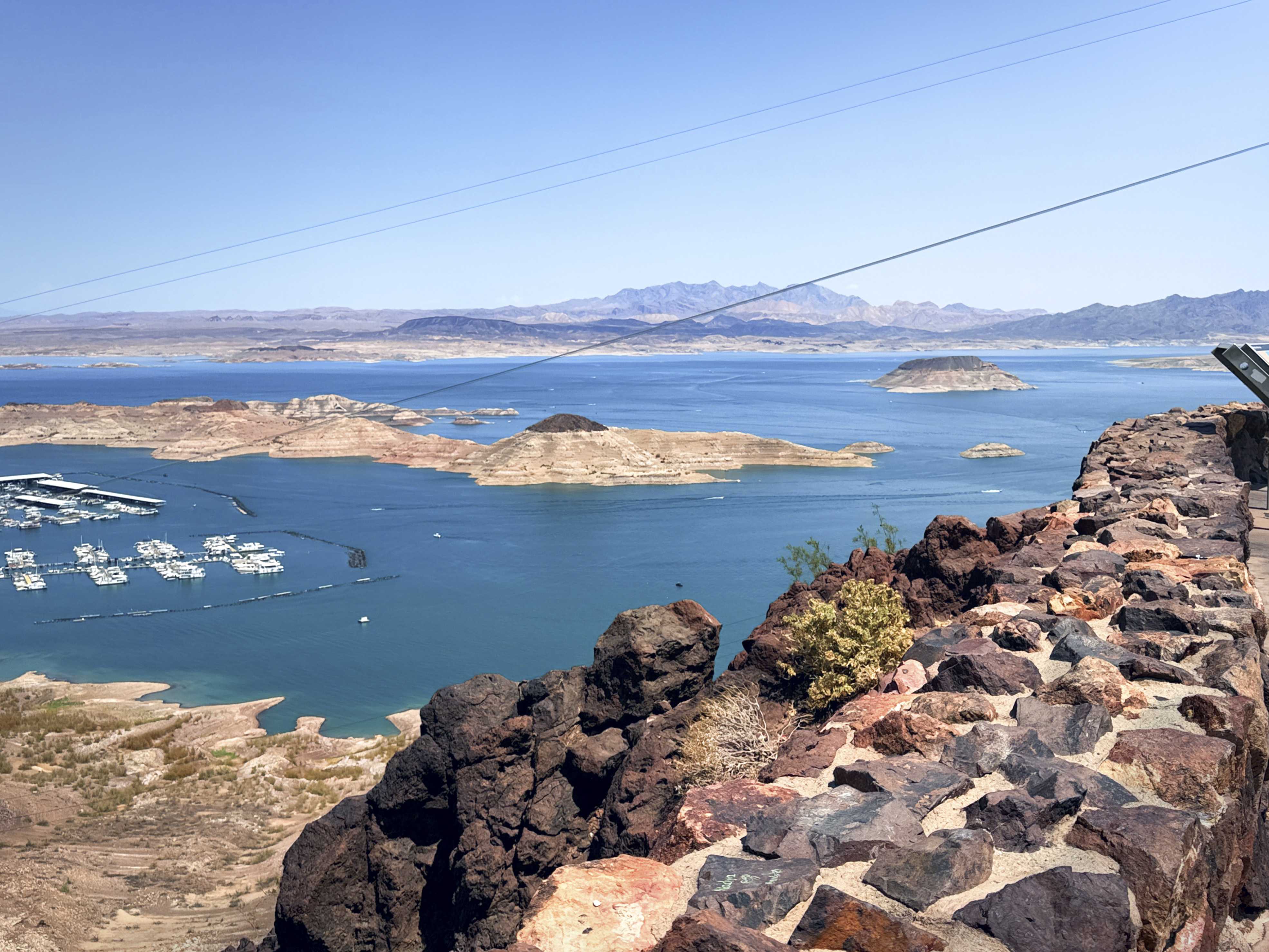

Lakeview Scenic Overlook is a convenient roadside viewpoint near Hoover Dam Access Road within Lake Mead National Recreation Area, making it an excellent stop before or after visiting Hoover Dam. From the accessible parking area, travelers can enjoy a broad panorama of Boulder Basin without undertaking a hike. Looking northwest, visitors can identify Hemenway Harbor, power lines extending from Hoover Dam, and a tunnel associated with the historic railroad used during the dam’s construction; toward the northeast are Rock, Boulder, and Saddle islands, with Callville Mesa and the Muddy and Black mountains forming the distant skyline (National Park Service [NPS], 2024a).
For science-minded visitors, the overlook presents a striking meeting of geology and engineering. Some of the oldest exposed rocks around Lake Mead—including the gneiss, schist, and granite found at Saddle Island—formed approximately 1.7 billion years ago, while later crustal stretching, faulting, and volcanism helped create the rugged Basin and Range landscape visible today. Beginning around 17 million years ago, regional extension raised mountains, lowered basins, and opened pathways for magma; erosion by the ancestral Colorado River subsequently carved through this complex terrain (NPS, 2026a). Fluctuating lake levels may also reveal a pale-colored “bathtub ring” on the surrounding rock, recording minerals deposited when the reservoir stood higher.
The blue reservoir contrasts dramatically with its dry Mojave Desert surroundings, but the landscape is biologically richer than it first appears. Creosote bush, bursage, cacti, and other drought-adapted plants occupy nearby slopes and washes, while animals commonly remain in shade or become active during cooler hours to conserve water. Patient observers may see ravens, gulls, waterfowl, lizards, desert cottontails, or—on distant rocky slopes—desert bighorn sheep; Lake Mead and its shoreline also support native and introduced fishes and numerous aquatic birds (Chandra et al., 2012; NPS, 2024b). Visitors should observe wildlife from a distance and avoid feeding animals, particularly because desert species depend on specialized behaviors to survive extreme heat and scarce water.
The view is also a window into twentieth-century Western history. Hoover Dam was built during the Great Depression, with construction beginning in 1931 and finishing in 1936; impounding the Colorado River created Lake Mead, named for Bureau of Reclamation commissioner Elwood Mead. The surrounding parklands were initially managed as Boulder Dam Recreation Area and became the nation’s first formally designated national recreation area in 1964 (NPS, 2024c). Recent Lake Mead research has focused increasingly on ecological consequences of changing reservoir levels: a 2025 scientific review found that declining water levels in reservoirs are often associated with a greater likelihood of increased cyanobacteria, while emphasizing the need for Lake Mead–specific monitoring of algae and potential pathogens as water levels fluctuate (Hoffman et al., 2025).


References:
Chandra, S., et al. (2012). Wildlife and biological resources: Chapter 5 in A synthesis of aquatic science for management of Lakes Mead and Mohave. U.S. Geological Survey. https://doi.org/10.3133/cir13815
Hoffman, K. K., Deemer, B. R., Lofton, M. E., Gibney, N. D., & Carey, C. C. (2025). Assessing risk for enhanced cyanobacteria, phytoplankton, and pathogens with changes in water level regime with potential application to Lake Powell and Lake Mead: A mixed methods literature review. National Park Service. https://doi.org/10.36967/2307521
National Park Service. (2024a). Lakeview Scenic Overlook. https://www.nps.gov/places/lakeview-scenic-overlook.htm
National Park Service. (2024b). Wildlife: Lake Mead National Recreation Area. https://www.nps.gov/lake/learn/nature/wildlife.htm
National Park Service. (2024c). History and culture: Lake Mead National Recreation Area. https://www.nps.gov/lake/learn/historyculture/index.htm
National Park Service. (2026a). Geology: Lake Mead National Recreation Area. https://www.nps.gov/lake/learn/geology.htm
AI Disclosure Statement:
Artificial intelligence tools were used in the creation of this page, including elements such as writing, image enhancement, voice enhancement, and/or editing support. All final creative decisions were made by the creator.

Leave a Reply