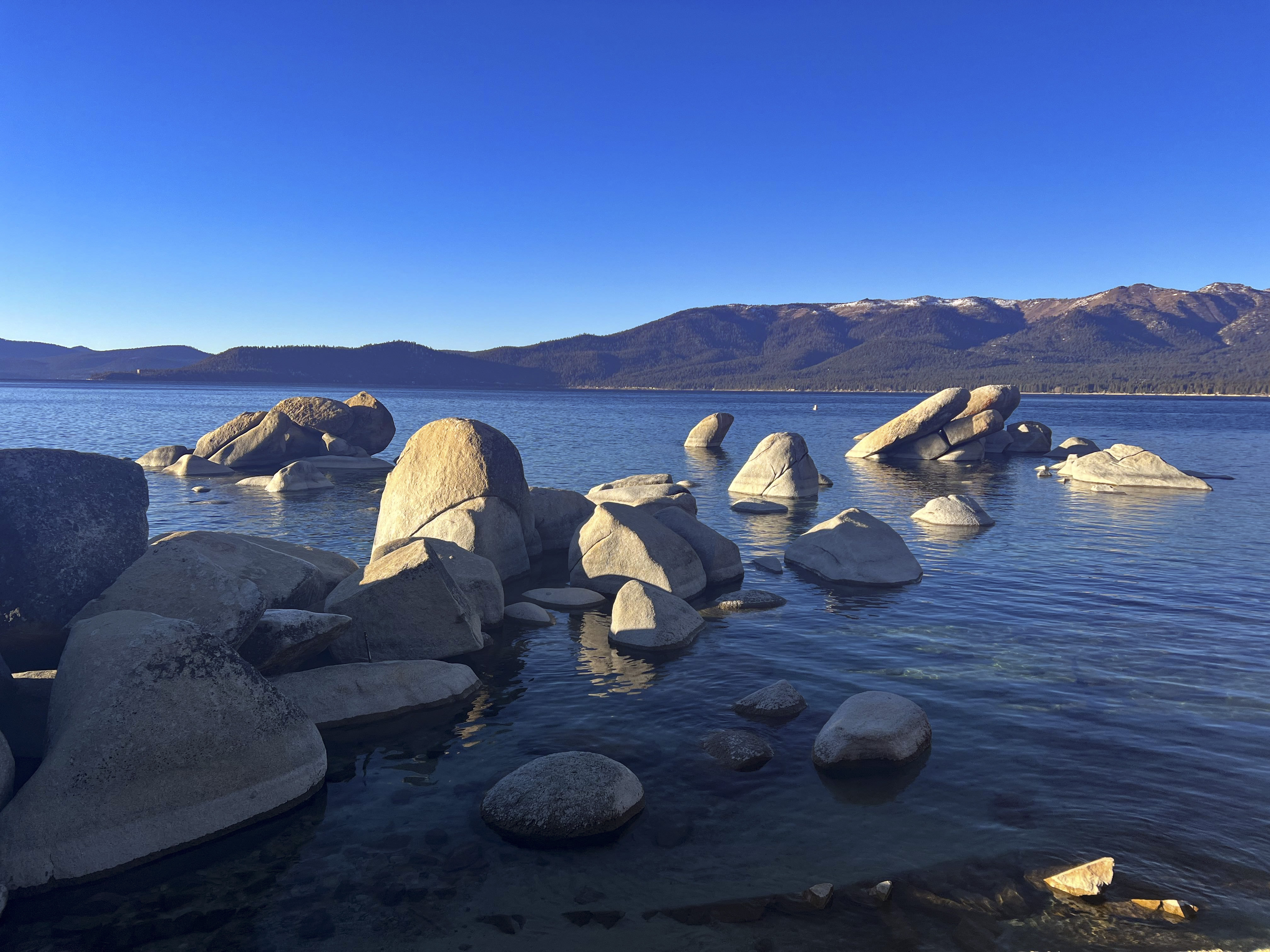

Sand Harbor is a scenic day-use area within Lake Tahoe Nevada State Park, located on the northeastern shore of Lake Tahoe near Incline Village. It is famous for its clear blue water, sandy beaches, sheltered coves, and enormous rounded granite boulders. Visitors can swim, kayak, paddleboard, scuba dive, picnic beneath Jeffrey pines and cedars, or walk the short Sand Harbor Nature Trail. The park also hosts the Lake Tahoe Shakespeare Festival beside the lake each summer—an unusual setting where theater performances take place against a mountain-and-water backdrop (Nevada State Parks, n.d.-a).
The park is generally open from 8:00 a.m. until one hour after sunset, and camping is not permitted. Because Sand Harbor becomes extremely crowded during summer, vehicle reservations are required before 10:30 a.m. daily from May 15 through September 30; after 10:30 a.m., entry is first-come, first-served when space remains. Travelers can also reach the park by walking or bicycling along the paved Tahoe East Shore Trail, but walking beside or being dropped off on Highway 28 is prohibited. Visitors should reserve early, check weather and road conditions, and remember that Lake Tahoe’s cold water can be dangerous even on warm days (Nevada State Parks, n.d.-a, n.d.-b).

Sand Harbor’s scenery reflects the dramatic geological history of the Lake Tahoe Basin. The basin began forming approximately two to three million years ago when faulting lowered large blocks of Earth’s crust between rising mountains. Its eastern shoreline is dominated by granitic bedrock related to the Sierra Nevada, while weathering and erosion gradually created the park’s pale sand and sculpted its granite outcrops into smooth, rounded forms (U.S. Geological Survey, 1997). Jeffrey pines and other conifers around the shoreline provide food and shelter for black bears, mule deer, chipmunks, squirrels, woodpeckers, chickadees, nuthatches, and other birds. The clear shallows also support fish, aquatic insects, algae, and microscopic plankton, while mandatory boat inspections help protect the lake from invasive quagga and zebra mussels (Nevada State Parks, n.d.-a, n.d.-c; U.S. Forest Service, n.d.).
The area also has a rich human history. The Washoe people traditionally spent summers at Sand Harbor fishing, hunting, and gathering before logging operations transformed the shoreline during the late 1800s; the park officially opened to the public in 1971 (Nevada State Parks, n.d.-d). Recent Lake Tahoe-wide research remains important to Sand Harbor’s future. UC Davis scientists reported in 2026 that the lake’s average water clarity was 69.2 feet during 2025—seven feet clearer than in 2024, although the long-term trend remained statistically unchanged. Researchers are now investigating unusually high concentrations of tiny suspended particles during summer and using advanced drones to monitor shoreline algae. They also report that warming temperatures, fewer freezing days, and earlier snowmelt are changing lake mixing, nutrient movement, water temperature, and the broader ecosystem (UC Davis Tahoe Environmental Research Center, 2026).


References:
Nevada State Parks. (n.d.-a). Sand Harbor—Lake Tahoe Nevada State Park.
Nevada State Parks. (n.d.-b). Sand Harbor reservations.
Nevada State Parks. (n.d.-c). Natural resources and climate for Lake Tahoe Nevada State Park.
Nevada State Parks. (n.d.-d). History of Sand Harbor—Lake Tahoe Nevada State Park.
UC Davis Tahoe Environmental Research Center. (2026). State of the Lake 2026: Fifty years of discoveries and looking toward the future.
U.S. Forest Service. (n.d.). Pinus jeffreyi, Jeffrey pine.
U.S. Geological Survey. (1997). Hydrogeology of Lake Tahoe Basin, California and Nevada.
AI Disclosure Statement:
Artificial intelligence tools were used in the creation of this page, including elements such as writing, image enhancement/generation, voice enhancement, and/or editing support. All final creative decisions were made by the creator.

Leave a Reply