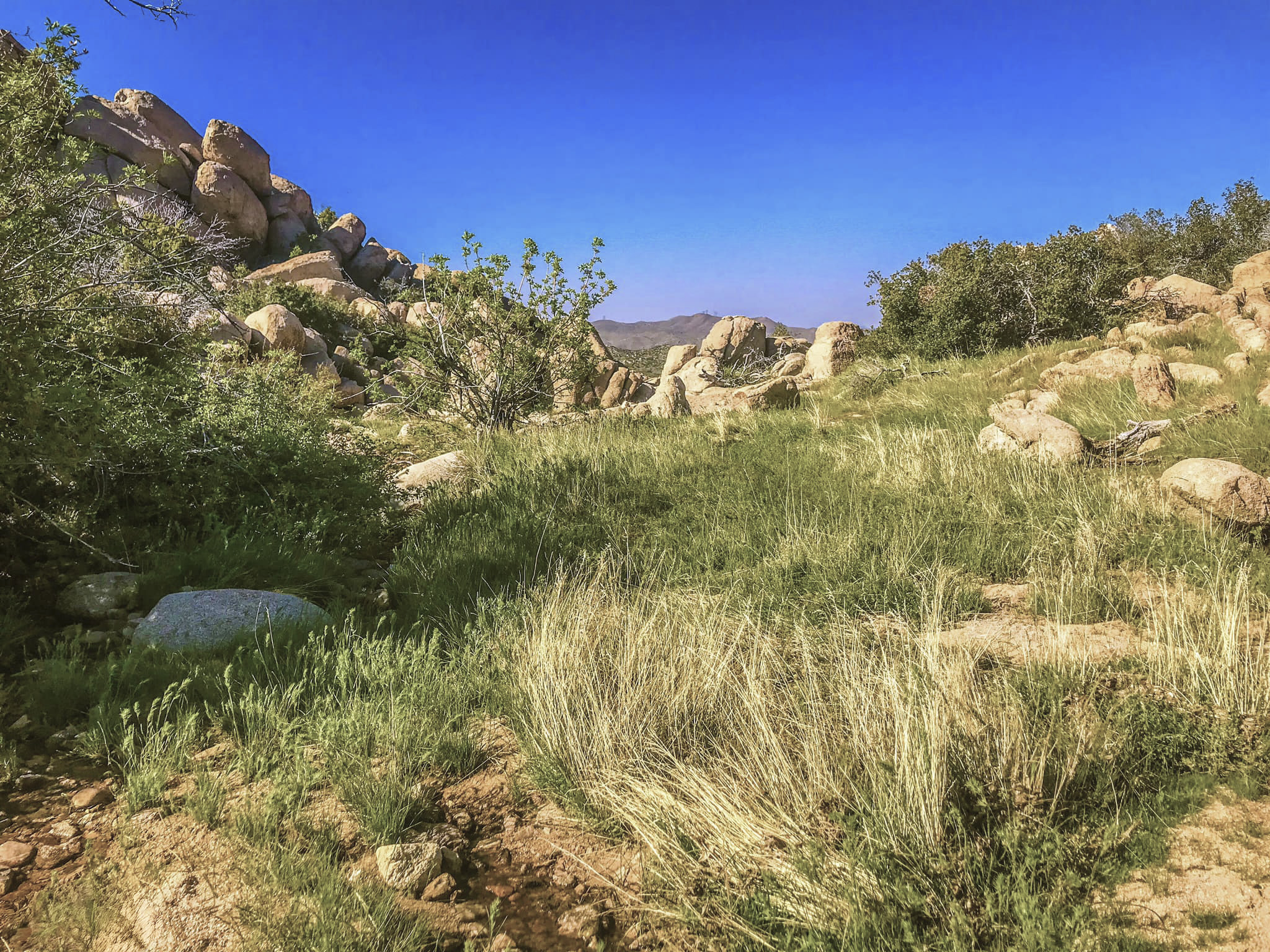

The Arrowhead Pinnacles are a cluster of small granite peaks northwest of Lake Arrowhead in Southern California’s San Bernardino Mountains. Located within the San Bernardino National Forest near CA‑173, the area combines rugged boulder fields, open chaparral, seasonal stream channels, grassy clearings, and scattered woodland. Unlike the volcanic formations of Pinnacles National Park in central California, the Arrowhead Pinnacles are composed mainly of granitic rock and form part of the mountain landscape overlooking the Mojave Desert (U.S. Geological Survey [USGS], 1973).
The primary hiking route is Pinnacles Trail 3W16, a difficult out-and-back trail beginning near the rifle-range entrance along CA‑173, north of Rock Camp. The route climbs through rocky terrain and requires some scrambling over large boulders near the summit, where hikers can enjoy broad views of the surrounding mountains and, on clear days, the Mojave Desert (Lake Arrowhead Communities Chamber of Commerce, n.d.). Visitors can also photograph the unusual formations, observe spring wildflowers, watch birds, explore seasonal creeks, or pursue technical rock climbing where permitted. Parking is limited, so hikers should bring plenty of water, wear sturdy footwear, avoid disturbing the pools and vegetation, and check current weather, fire danger, road conditions, pass requirements, and forest closures before visiting (U.S. Forest Service [USFS], n.d.-a).

Geologically, the rounded boulders and rocky ridges are exposed portions of ancient intrusive rock that cooled slowly beneath Earth’s surface before uplift and erosion revealed them. The regional bedrock includes granitic and granodioritic units, while faults and continuing tectonic deformation have helped raise and shape the San Bernardino Mountains (Dibblee, 1973; USFS, n.d.-b). Natural fractures allowed water and chemical weathering to attack the rock from several directions, gradually rounding large blocks through a process known as spheroidal weathering. Seasonal runoff then transports sand and smaller fragments into hollows and channels, producing the shallow pools, sandy ground, and green spring meadows visible among the boulders.
The open slopes support drought-tolerant chaparral plants such as manzanita, ceanothus, sagebrush, and buckwheat, while grasses and annual wildflowers become especially noticeable after wet winters; sheltered drainages may support willows, oaks, and other plants requiring greater moisture. Wildlife that may use this varied habitat includes mule deer, coyotes, bobcats, mountain lions, cottontail rabbits, ground squirrels, lizards, rattlesnakes, hawks, ravens, and numerous smaller birds and pollinating insects. In the broader forest, California spotted owls depend strongly on mature, structurally diverse woodland: research conducted in the San Bernardino and San Jacinto Mountains found that tall, heterogeneous forests improved owl hunting success and reproduction (Wilkinson et al., 2023). More recent statewide research found that extensive high-severity wildfire made spotted-owl territories more likely to become vacant and that the birds generally avoided severely burned forest, emphasizing the importance of reducing the risk of unusually large, severe fires while preserving a varied habitat mosaic (McGinn et al., 2026).


References:
Dibblee, T. W. (1973). Geologic map of the Lake Arrowhead quadrangle, California (Open-File Report 73-56). U.S. Geological Survey. https://doi.org/10.3133/ofr7356
Lake Arrowhead Communities Chamber of Commerce. (n.d.). Hiking guide: Pinnacles Trail 3W16. https://www.lakearrowheadchamber.com/hiking-guide/
McGinn, K., Peery, M. Z., Keane, J., Roberts, K., Dotters, B., Whitmore, S. A., Berigan, W. J., Gallagher, L. R., Shaklee, P. A., Munton, T. E., Hart, R., Gutiérrez, R. J., & Jones, G. M. (2026). Impacts of wildfire on spotted owls in California: A bioregional-scale data synthesis. Wildlife Monographs, 224(1), e70014. https://doi.org/10.1002/wmon.70014
U.S. Forest Service. (n.d.-a). San Bernardino National Forest. https://www.fs.usda.gov/r05/sanbernardino
U.S. Forest Service. (n.d.-b). Geology of the San Bernardino National Forest. https://www.fs.usda.gov/detail/sbnf/learning/nature-science/?cid=fsbdev7_007775
Wilkinson, Z. A., Kramer, H. A., Jones, G. M., Zulla, C. J., McGinn, K., Barry, J. M., Sawyer, S. C., Tanner, R., Gutiérrez, R. J., Keane, J. J., & Peery, M. Z. (2023). Tall, heterogeneous forests improve prey capture, delivery to nestlings, and reproductive success for spotted owls in Southern California. Ornithological Applications, 125(1), duac048. https://doi.org/10.1093/ornithapp/duac048
AI Disclosure Statement:
Artificial intelligence tools were used in the creation of this page, including elements such as writing, image enhancement, voice enhancement, and/or editing support. All final creative decisions were made by the creator.


Leave a Reply